

DDM Systems launches Digital Foundry for tool-free investment casting
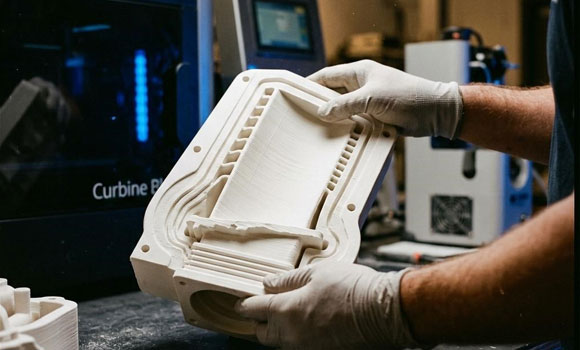
DDM Systems, Inc, an advanced manufacturing company specialising in ceramic Additive Manufacturing for investment casting, based in Atlanta, Georgia, USA, has announced the commercial launch of its Digital Foundry platform, a manufacturing approach designed to eliminate tooling from the investment casting process and deliver precision metal castings in days rather than months.
TRUSTED BY INDUSTRY’S BIGGEST NAMES
Discover how we help leading brands shape the industry conversation
| Contact us |
With the United States reported to be facing an unprecedented contraction in its casting and forging industrial base, having lost 67% of its foundries since 2000 according to the American Foundry Society, aerospace investment casting lead times can now stretch to 18 months or longer.
Meanwhile, demand from defence programmes, gas turbine manufacturers, and aerospace OEMs continues to accelerate. America Makes’ IMPACT 3.0 project call, released in September 2025 with $4.5 million in funding, named its first topic area ‘AM in the Digital Foundry,’ signalling federal recognition that Additive Manufacturing must augment the casting industrial base.
“The American casting industry has been hollowed out over decades, and the consequences are now showing up in every major defence and energy programme in the country. Our Digital Foundry is not a prototype or a concept. It is a production-ready platform that is already delivering castings for the US Air Force, gas turbine manufacturers, and aerospace OEMs,” explained Dr Suman Das, founder, President, and CEO of DDM Systems, and Morris M Bryan Jr, Chair Professor in Mechanical Engineering for Advanced Manufacturing Systems at Georgia Institute of Technology.
The Digital Foundry platform combines three technologies developed by DDM: LAMP, DirectPour and SLE. LAMP (Large Area Maskless Photopolymerisation) uses patterned ultraviolet light to produce ceramic investment casting shells directly from CAD data. According to the company, this reduces the number of process stages required in conventional lost-wax casting.
The second technology, DirectPour, provides ready-to-pour ceramic shells with integrated cores for foundry partners. The third, SLE (Scanning Laser Epitaxy), is intended for the Additive Manufacturing of single-crystal, directionally solidified and equiaxed superalloy structures for turbine blade repair and production.
According to DDM, the platform can reduce lead times by up to a factor of ten, enabling first castings to be delivered in as little as ten days, compared to typical lead times of 52–80 weeks using conventional methods. The company also reports the elimination of upfront tooling costs and a reduction in scrap rates of approximately 90%.
DDM states that it holds more than twenty-six patents across six countries and is registered under the International Traffic in Arms Regulations (ITAR). The company is also a member of the Defense Industrial Base Consortium and the Cornerstone OTA.
The Digital Foundry platform is reported to be compatible with a wide range of air-melt and vacuum-melt alloys, including stainless steels, aluminium alloys and nickel-based superalloys. DDM states that castings produced using the platform meet applicable ASTM standards and Investment Casting Institute acceptability criteria.
“We built this technology over fifteen years with DARPA and ARPA-E support, specifically to solve the problem of a shrinking domestic casting base. The Digital Foundry does not replace foundries. It removes the tooling bottleneck that prevents foundries from responding to demand at the speed the defence and energy sectors require,” Das added.