

Ceramic piston and rod additively manufactured for Chaos ultracar
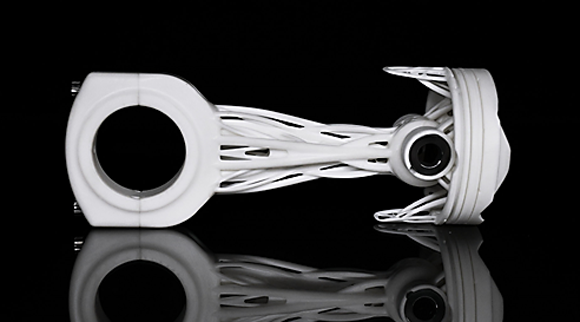
Spyros Panopoulos Automotive (SPA), Acharnes, Greece, has developed what is reported to be the first additively manufactured engine piston made entirely from ceramic for its Chaos ultracar. Using technology from XJet, Rehovot, Israel, the lightweight ceramic piston and rod is said to offer extraordinary strength, hardness and resistance to thermal expansion.
The Chaos, which is currently in development, reputedly has the fastest-revving production car engine ever seen, reaching up to 12,200 RPM and 3,065 horsepower. The ultracar is expected to reach speeds of over 500 kph and acceleration from 0 to 100 kph in 1.55 seconds.
SPA founder Spyros Panopoulos explains that to make the engine a reality and support the extreme levels of performance required, the ‘anadiaplasi’ piston was designed. Anadiaplasi is Panopoulos’ proprietary method of Design for Additive Manufacturing (DfAM) in which a component takes its shape based on the forces acting on it. Material is minimised where it doesn’t support performance and added where reinforcement is needed, optimising weight while maintaining the strength and temperature resistance of the part – essential for any piston, but particularly testing in such a high-performing engine. The result is an organic complex shape that is both light and strong.
On concluding the design, Panopolous realised that to produce such complex geometry – along with the high accuracy and excellent surface finish required – the only relevant manufacturing technology was Additive Manufacturing. The company then selected XJet’s Nanoparticle Jetting technology and, in collaboration with XJet’s Greek business partner Lino 3D, selected XJet alumina material for the Chaos piston.

“Ceramic offers many advantages compared to other materials,” stated Panopolous. “Harder and stiffer than steel, more resistant to heat and corrosion than metals or polymers and weighing significantly less than most metals and alloys. XJet’s alumina parts will withstand the high temperatures expected to develop within the combustion chamber as well as on the fast-moving parts.”
“XJet systems are uniquely capable of producing this part in ceramic, and there’s absolutely no room for error in this project,” he added.
An advocate of Additive Manufacturing, Panopolous is putting it to use throughout the Chaos Ultracar with a reported 78% of the body being additively manufactured, as well as other crucial elements such as the engine block, camshaft and intake valves.
“We are proud to be using such progressive technology in our Ultracar,” Panopolous added. “Our projects push performance to the extreme and so we are extremely selective about the materials and technologies we use. I believe this is the first-time ceramic AM is being used in motorsport and I feel privileged to take that pioneering step.”
Haim Levi, XJet VP Strategic Marketing, concluded, “SPA is taking ceramic Additive Manufacturing and Design for AM – DfAM – to the edge and beyond with their work on the Chaos Ultracar. We’re extremely proud to be part of such a trailblasing project by offering the top-level capabilities of our technology and system. Designers and engineers from a wide range of industries and applications are exposed to new options now opened for them. We expect the Chaos project ceramic piston to ignite their creativity and imaginations and push the limits in the automotive industry and beyond.”