

Metal and ceramic injection moulding: A guide for designers and end-users
This article is based on ‘Designing for Metal Injection Moulding: A Guide for Designers and End-Users’, by Professor Randall German, published in the December 2008 issue of PIM International. Professor German is Associate Dean of Engineering at the College of Engineering, San Diego State University, USA and a Consulting Editor of PIM International.
Presented on the following pages are some effective guidelines that end-users need to consider when looking to use the Metal Injection Moulding (MIM) route for the production of components.
As this online feature clearly demonstrates, the greater the understanding of the MIM process that a designer has, the greater the chances of successful adoption of MIM technology.
Although prepared with Metal Injection Moulding in mind, the design considerations presented are also applicable to Ceramic Injection Mouling (CIM).
TRUSTED BY INDUSTRY’S BIGGEST NAMES
Discover how we help leading brands shape the industry conversation
| Contact us |
Introduction
Assuming the reader has some prior knowledge about Metal Injection Moulding, this article deals with the design factors that improve production.
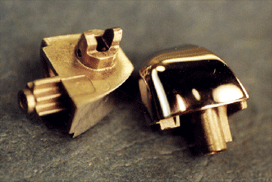
It is during the design phase that changes can be made to avoid later difficulties that might interrupt or delay production schedules.
With experience, a trained designer will envision the MIM process from the start, enabling higher process yields, lower costs, and faster processing.
Whole books have been written on the design aspects of Metal Injection Moulding [1], so here the effort is to outline some of the important principles.
More than anything, early involvement by a MIM vendor helps the most. Costs incurred during design have little impact on the final product price, but decisions made during design have major implications on the production costs. Vendor consultation before a design becomes fixed will save agony and cost during production [2].
The first questions
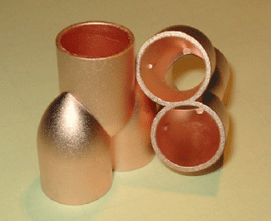
The Metal Injection Moulding process allows for complex net-shape components from a variety of compositions. Cost in Metal Injection Moulding depends on the material and several other factors, including the component mass, tooling complexity, mould cycle time, debinding and sintering times and other factors.
Because Metal Injection Moulding is similar to plastic molding, certain shapes are more attractive while other shapes prove difficult. The following page poses the some initial questions that help determine if MIM is viable.
Continue to next page: When is a part suitable for Metal or Ceramic Injection Moulding?