

CIM zirconia dental implants seen as alternative to alumina and titanium
As published in PIM International Vol 6 No 2 June 2012
Problems with previous ceramic implant materials such as aluminium oxide led to initial reservations in the dental world about the use of zirconia. Now these reservations are being overturned by Maxon Dental, the dental business of Maxon Motor GmbH in Marburg, Germany, with its ceramic injection moulded (CIM) high performance yttrium-stabilised zirconia dental implants, branded OMNIS. These CIM zirconia implants are said to have two to three times greater rigidity than aluminium oxide, and are said to have better biocompatibility than titanium implants, which can, it is stated, give rise to chronic inflammation in some patients.
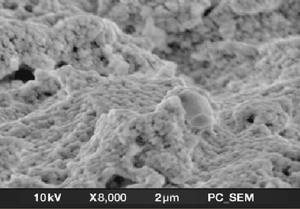
Fig. 1 The specially developed surface structure
developed by Maxon Dental on the CIM zirconia
implant guarantees optimum osseointegration
and matches that of etched titanium implants
Dr. Norbert Grafe and Dr. Birgit Lehnis state in a Maxon Dental report that the specially designed surface structure of the CIM zirconia implant materials is said to guarantee rapid and secure osseointegration (Fig. 1), which matches that of etched titanium implants. They state that Maxon Dental uses ceramic injection moulding to produce the OMNIS implants because of the complex shape, high sintered density and unique surface structure that can be achieved by the CIM process. The company uses a fine zirconia powder (0.3 µm) containing 5 vol. % of yttrium oxide, which is blended with a thermoplastic binder and granulated to produce the injection moulding feedstock.
The authors of the report state that the zirconia used for the one-piece OMNIS implant exists in three different phases. At room temperature, the monocline phase is normally stable; when warmed, the monocline phase changes into the tetragonal phase; if the temperature rises further, this becomes the cubic phase. The tetragonal phase demonstrates favourable values for implantology in terms of rigidity and fracture toughness. A few more percent Y2O3 is added to keep the tetragonal phase stable at room temperature. Fine ceramic powder is mixed with a thermoplastic binder system to form a material that can be injection moulded. This compound can be processed as freely as with plastic injection moulding. The compound is poured into the injection moulding equipment and injected into a tool at high pressure, producing the implant’s green body.
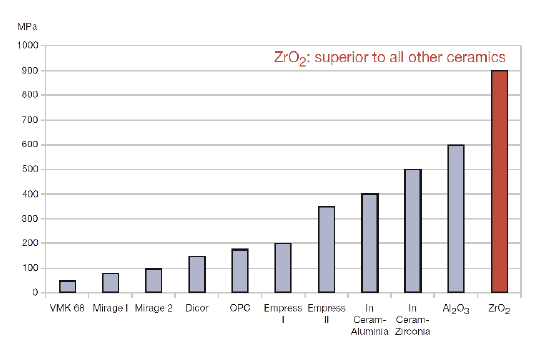
Fig. 2 Zirconia ceramics are more flexible than Al2O3 in conjunction with a lower elasticity modulus (Al2O3 350 x 103 N/mm2, ZrO2 200 x 103 N/mm2) (Courtesy Maxon Dental)
After high pressure injection moulding, the green parts undergo debinding at 120°C in a protective atmosphere, and are finally sintered at 1500°C to reach a density of ~6.05 g/cm3. The sintered implant material does not require a post-hot isostatic pressing operation. Properties include: hardness ~1350 HV, bending strength of 800 – 1200 n/mm2, elastic modulus 2 x 10⁵ N/mm2, and a co-efficient of thermal expansion of 10 x 10-6 K-1. The report from Maxon Dental includes a detailed description of how a patient was successfully treated with a ceramic injection moulded OMNIS implant.
www.maxondental.de