
Metal Injection Molding for firearms and defence applications
MIM titanium gun trigger
Fig. 35 shows a MIM titanium trigger produced for an Italian gun manufacturer. In the background is the green part (as moulded) and in the foreground the sintered part.
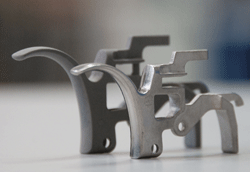
Because of high material costs, Metal Injection Moulded titanium components are currently limited to high performance applications (in terms of fatigue properties, biocompatibility, and light weight), or luxury consumer products where titanium adds exclusivity and marketability.
As titanium powder prices fall, the market for MIM components is expected to grow dramatically.
“Safe and Arm” rotor
The military “safe and arm” rotor shown in Fig. 36 is used in an explosive device for a US Department of Defence application. Produced by Metal Injection Moulding, the 316L stainless steel part is formed to a density of 7.6 g/cm3. Its significant properties include an ultimate tensile strength of 75,000 psi, yield strength of 25,000 psi, 50% elongation and 67 HRB hardness.
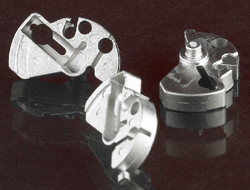
The complex shape features numerous outside radii and angular surfaces. At least twelve functional features and surfaces are geometrically controlled by concentricity, profile, and true position tolerances.
The part is assembled into a housing to provide the two-stage safety for the explosive device. It replaced a zinc die casting whose mechanical properties were ultimately not consistent enough to pass validation testing.
Pistol upswept grip safety part
This pistol safety part (Fig. 37) is used in the 1911-style 45-caliber pistol made by Colt Manufacturing Company, LLC., USA. The complex MIM 17-4 PH stainless steel part is produced to a density of 7.6g cm3.
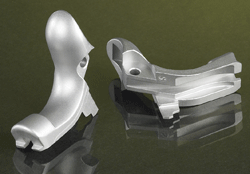
The upswept design of the grip safety part, which was traditionally investment cast, would previously require extensive secondary machining. Switching to the MIM process reduced customer lead times and provided exceptional cost savings, in addition to increasing production rates and producing a more uniform part.
The part performs several functions: it blocks the trigger from firing, shields the hammer from impacting or injuring the shooter’s hand when the pistol cycles, and interacts with the shooter’s palm for comfort. Colt performed a 10,000-cycle test to qualify the part.
To learn more about MIM in the firearms sector, download our free to access report “Metal Injection Moulding in the firearms industry: A global perspective“, available in the December 2014 issue of PIM International.
Next page: Conclusions
Download PIM International magazine