
Conclusions
Metal Injection Molding technology’s inherent advantages
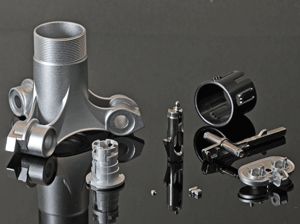
The typical Metal Injection Molded part combines a relatively small size, high complexity of shape, high strength, medium to high surface finish and moderate to close dimensional tolerances.
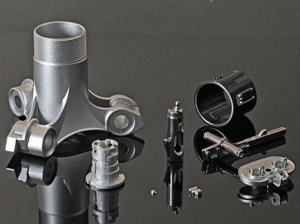
Being a net-shape process, Metal Injection Molding is most competitive where costly machining operations can be avoided and where the number of parts required is sufficiently high to justify the cost of the mould.
The capability to design complex shapes has often led to new part designs for Metal Injection Molding, combining the functions of a multi-part assembly in a single component.
Metal Injection Molding’s limitations
The Metal Injection Molding process allows for a high degree of automation and is therefore most competitive in volume production, typically ranging from 20,000 to many millions for parts per year.
MIM parts can be designed with extremely thin walls, fine bore holes, threads and other details. This helps to save weight and material cost.
The competitiveness of Metal Injection Molding is limited by the relatively high raw material cost as compared to cast metals and alloys. This is the main reason why MIM parts are usually rather small, as the material cost of a small part contributes a smaller portion of the total manufacturing cost.
Last, but not least, the process is environmentally friendly and needs less energy input than competing processes and there is very little waste thanks to the MIM’s net shape capabilities.
The industry today: Diverse, transparent and flexible
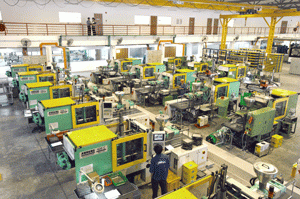
Today this has changed dramatically. There are more than 500 parts producers worldwide, ranging from small niche operations to major continuous manufacturing plants that are easily able to serve the needs of major users, such as the automotive and 3C industries.
Parts producers are in turn supported by a growing number of material suppliers offering ready-to-mould MIM feedstocks, as well as the necessary know-how for processing parts.
Equipment suppliers offer injection moulding machines customised ready for MIM and furnaces can be bought from a range of suppliers that are tailored specifically for MIM processing.
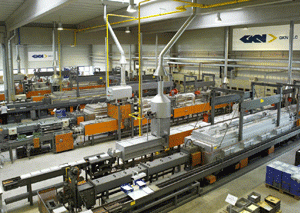
As a consequence, companies without any previous experience in Powder Metallurgy, such as plastics injection moulding and investment casting companies have started to enter MIM technology and have been successful.
Diversification, specialisation and availability of know-how have led to a rapid increase in the number of parts manufacturers. MIM products are now well accepted with major OEMs and consequently the industry is seeing a proliferation of new MIM applications.
> Back to index
Download PIM International magazine