

Zortrax M300 Dual now compatible with BASF Ultrafuse stainless steel
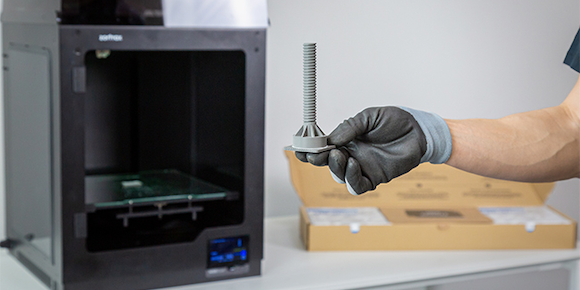
Zortrax, based in Olsztyn, Poland, has announced an update for its M300 Dual Additive Manufacturing machine that allows users to make parts out of either BASF Ultrafuse 316L or 17-4 PH stainless steel filament, as well as an upgrade for its Z-SUITE software package.
The Ultrafuse filaments, included in Zortrax’s Full Metal Package, includes all necessary components to make metal parts and was first introduced by the company for its industrial AM machines last year.
Using the Ultrafuse filament results in a ‘green’ part comprising of 80% metallic powder and 20% polymer filler. To turn this into a fully functional part it must undergo a two-part post-processing stage developed by BASF. In the first stage, the polymer filler is separated from the metallic powder through thermal and chemical treatment. The second stage takes place once the polymer filler is removed, with the remaining metallic part being sintered.
Zortrax has also updated its Z-SUITE software in an effort to further align with the needs of Additive Manufacturing users and the nature of the two-stage post-processing that turns ‘green’ parts into steel. The most important features in this area include a new gyroid infill which enables build metal models with 60-90% infill. This is useful in industries like aerospace or automotive where the weight of the part has to be minimised.
Additionally, the update has reportedly improved the way that support structures are additively manufactured while building with BASF Ultrafuse Support Layer. In Z-SUITE 3.2.0 BETA, supports are separated along the Z-axis and divided down into small blocks along the XY-plane to make their removal easier after post-processing. For the same reason, support structures are also narrowed towards the bottom, thereby reducing the supports’ footprint on the model. This is said to especially apply to getting rid of supports placed in small crevices or other areas in the parts that are difficult to access.
Support structures’ deformation caused by shrinkage of the part is further reduced due to switching the direction of manufacturing from one layer to another. Z-SUITE 3.2.0 BETA reportedly changes the way the shrinkage plates are additively manufactured to maximise dimensional accuracy of parts that rest on such plates.