

Research highlights increase in fatigue life following compressive stresses applied to MIM components
Researchers from Universidade Federal do Rio Grande – FURG, Rio Grande, Brazil, recently published a paper in Surfaces focusing on the behaviour of catalytic low-alloy steels manufactured via Metal Injection Molding which have undergone compressive stress.
While MIM processes have made advances in the production of components with complex geometries, small dimensions, and high production volumes, the combination of MIM with post-processing technologies such as Hot Isostatic Pressing (HIP), uniform polymer extraction, and reduced-temperature sintering has been under-studied, the authors state. To expand this knowledge base, ‘Analysis of Fatigue Life After Application of Compressive Microstresses on the Surface of Components Manufactured by Metal Injection Molding’ analysed the behaviour of Catamold 100Cr6 steel subjected to quenching and tempering heat treatment in different microhardness ranges, and the effect of compressive stresses on the samples obtained by polishing using ceramic microchips.

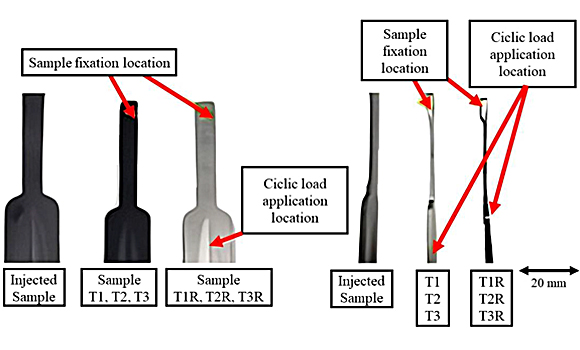
The study’s samples – characterised using optical microscopy, scanning electron microscopy (SEM), an EDS microprobe, and X-ray diffraction – were subjected to elastic return cycling and an experimental device developed to apply a 19° bending angle. The findings report a significant increase in fatigue life due to the compressive stresses (up to around 430 MPa) generated by the reduction in retained austenite and surface plastic micro deformation, indicating the effectiveness of 100Cr6 Catamold steel in cyclic applications.
Based on the study, the researchers noted that the components produced with MIM Catamold 100Cr6 demonstrated the ability to withstand cyclic stresses below the yield limit in quenched and tempered conditions. The applied tempering range presents a relevant factor for cyclic applications with elastic return applied.
The roto polishing surface finish with ceramic microchips was reported to significantly increase the cyclic fatigue life below the yield point; compressive residual stresses significantly increased the samples’ behaviour in experimental spring-back applications. Samples subjected to T3R conditions showed greater surface microhardness, higher compressive stress levels, and the ability to withstand cycles below the yield limit up to five times greater than T1R and T2R conditions.
Through the X-ray diffraction process, the researchers found that surface plastic micro deformations significantly affected the performance of the studied samples. Overall, the effects of surface plastic deformation were noted as having a favourable application in quenched and tempered Catamold 100Cr6 steel.
The full paper is available here.
www.furg.br