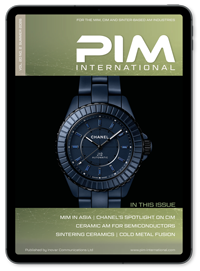


PIM International, Vol. 20 No. 1 Spring 2026
Prefer a PDF download? Click here
The 136-page Spring 2026 issue of PIM International (Vol. 20 No. 1) features over forty pages of industry news, plus the following articles and technical reviews:
Industrialising titanium: MTIG’s strategy for scalable, cost-competitive precision MIM and AM
Located at the heart of South Korea’s advanced manufacturing ecosystem, MTIG represents a new model for titanium industrialisation that goes far beyond conventional MIM-Ti parts production. By vertically integrating proprietary Hydride-Dehydride (HDH) powder production, Metal Injection Moulding, and Additive Manufacturing, MTIG delivers cost-competitive, high-precision titanium at scale.
In this article, Professor Dr Jai-Sung Lee interviews MTIG’s founder and CEO, Dr Ji-Hwan Park, to explore the technologies, vision, and full-cycle innovation that set MTIG apart within the global MIM industry.
| Get PDF | | | Read online |
Cooling the limits of power electronics: An integrated approach for e-mobility and AI hardware with copper MIM
As power density continues to rise in applications ranging from e-mobility to AI hardware, thermal management is increasingly defining the performance limits of power electronics. Conventional cooling concepts are struggling to keep pace, making system-level optimisation essential.
This article presents a coordinated approach to substrate design, high-current interconnection and advanced copper cooling enabled by Metal Injection Moulding, developed jointly by Schweizer Electronic AG, Schunk Sonosystems GmbH and Schunk Sintermetalltechnik GmbH, and authored by Marvin Luceri, Thorsten Klein and Tim Hanika.
| Get PDF | | | Read online |
Removing the bottleneck: Automating depowdering for scalable Binder Jetting
Binder Jetting (BJT) continues to attract intense interest as manufacturers search for faster, more economical routes to serial metal part production. Yet despite impressive build speeds and design flexibility, many remain sceptical about Binder Jetting’s readiness for true industrial scale. The bottleneck lies not only in the build process, but in what happens next. Depowdering, still largely manual and labour-intensive, threatens throughput, consistency and safety.
In this article, Lea Reineke of Fraunhofer IFAM and Florian Richter from IPH Hannover explain how the QualiJet project aims to change that.
| Get PDF | | | Read online |
Extending the limits of Ceramic Injection Moulding: Thick-section processing with water-extractable binder
Water-based debinding in Ceramic Injection Moulding (CIM) is widely adopted for its safety and environmental advantages over solvent or catalytic systems. However, conventional water-soluble binders limit processing when fine powders and thick cross sections coincide, as slow extraction can cause residual binder, blistering and cracking during thermal steps. By optimising binder chemistry, thick-walled (>5 mm) components can be processed defect-free, even with ultrafine powders.
Dr Rafael Olivera Silva of EnCeram explains how this approach expands the reliable CIM process window.
| Get PDF | | | Read online |
Sinter-based Additive Manufacturing technologies in focus at ASTM’s ICAM 2025 conference
Building on the previous ASTM ICAM 2024 review, Dr Animesh Bose highlights a selected set of ICAM 2025 presentations from the Value Chain track on sinter-based Additive Manufacturing. The 2025 sessions placed less emphasis on introducing new platforms and more on the practical requirements for industrial adoption – feedstock control, debinding and sintering optimisation, distortion and microstructure management, and qualification-relevant process monitoring across the powder-to-part workflow. This review captures how these priorities are shaping the track’s growing maturity and relevance for the Powder Metallurgy community.
| Get PDF | | | Read online |
< Back to 2026 archive