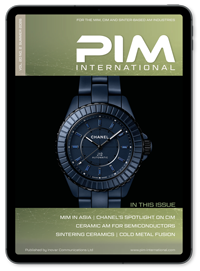


PIM International, Vol. 19 No. 3 Autumn 2025
Prefer a PDF download? Click here
The 132-page Autumn 2025 issue of PIM International (Vol. 19 No. 3) features over forty pages of industry news, plus the following articles and technical reviews:
Ceramic precision meets analogue performance: How Additive Manufacturing enables design freedom in high-end audio
There is a beauty in ceramics that has captivated us for thousands of years. Today, Additive Manufacturing (AM) is giving this material class renewed appeal by enabling the creation of forms previously impossible to produce, while preserving the mechanical, aesthetic and tactile qualities that make ceramics so valued.
A new award-winning Hi-Fi turntable cartridge – developed by HiFiction AG and technology – showcases not only design innovation but also how AM eliminates tooling barriers, making advanced technical ceramics more accessible to smaller businesses.
| Get PDF | | | Read online |
MPIF’s PM Design Excellence Awards 2025: Celebrating innovation in Metal Injection Moulding
The Metal Powder Industries Federation (MPIF) announced the winners of the 2025 Powder Metallurgy Design Excellence Awards at PowderMet2025 in Phoenix, Arizona. This article focuses on award-winning components produced by Metal Injection Moulding (MIM) and sinter-based Additive Manufacturing.
The awards recognise advances in efficiency, performance and reliability across industries. Collectively, the winning parts highlight MIM’s growing role in advanced manufacturing, demonstrating how the process combines precision, scalability and design freedom for demanding applications.
| Get PDF | | | Read online |
Sinter-based AM & MIM at the 21st Plansee Seminar: Cemented carbide and tungsten heavy alloy developments
The 21st Plansee Seminar, held in June 2025, provided deep insight into the evolving landscape of sinter-based Additive Manufacturing (AM) for cemented carbides and tungsten heavy alloys. Presentations explored Binder Jetting, Material Extrusion, Direct Ink Writing, and other emerging techniques, with a focus on microstructural control, process–property relationships, and feedstock optimisation.
While Binder Jetting remains influential, alternative approaches are gaining traction for finer powders and complex geometries. This article, authored by Bernard North, examines the key technical findings and perspectives shared at the event.
| Get PDF | | | Read online |
Atomik AM and the binder revolution: Rethinking the future of Binder Jetting
Binder Jetting has long been heralded as the Additive Manufacturing process most likely to deliver true mass production. Its promise of speed, scalability and lower costs has kept it in focus, but familiar challenges remain: fragile green parts, difficult depowdering, sintering distortion and a narrow materials palette. Atomik believes the answer lies in rethinking the binder itself. Far from being an inert glue, it may be the key to unlocking Binder Jetting’s future, argues the company’s Prof Kate Black.
| Get PDF | | | Read online |
Advances in water-debindable feedstock for Ceramic Injection Moulding: Thicker parts, faster cycles
Recent advances in water-debindable feedstocks are redefining what is possible in Ceramic Injection Moulding (CIM). By combining hydrophilic backbone chemistries with optimised surfactants and plasticisers, these formulations enable faster, safer debinding without compromising performance. This article presents comparative data demonstrating improved flow, reduced thermal load, and successful processing of parts beyond 10 mm wall thickness.
Drawing on developments at KRAHN Ceramics GmbH, Dr Thorsten Ohlerth examines kinetics, moulding behaviour, and sintering outcomes that signal a shift towards more sustainable CIM production.
| Get PDF | | | Read online |
Comparative study of 17-4 PH spur gears produced by Metal Injection Moulding and Binder Jetting
This study compares 17-4 PH stainless steel spur gears produced by Metal Injection Moulding (MIM) and Binder Jetting (BJT), focusing on dimensional accuracy, microstructure, and mechanical performance. As BJT gains traction in China’s manufacturing sector, the authors – Jie Li, Jimin Xu, and Guangfeng Zhong (Vigor Precision Hardware, Dongguan), alongside Yuder Chao and Yauhung Chiou (You Need Enterprise Consulting, Kunshan) – investigate whether BJT can match the precision and reliability of established MIM processes. The results show that while BJT is effective for early–stage prototyping, MIM offers superior consistency for high–precision components.
| Get PDF | | | Read online |
< Back to 2025 archive