

PARI researchers use additively manufactured dark ceramics to advance hypersonic components
Researchers at Purdue Applied Research Institute (PARI), Purdue University, Lafayette, Indiana, USA, are developing Additive Manufacturing processing methods to build dark ceramics – materials that can withstand the harsh conditions of hypersonic flight – into complex shapes for hypersonic vehicle components. The goal is to additively manufacture these components at scale to improve efficiency and performance.
Rodney Trice is a professor in the College of Engineering’s School of Materials Engineering and serves as the thrust lead in ceramic processing at PARI’s Hypersonics Advanced Manufacturing Technology Center (HAMTC). Trice is leading efforts to improve these materials specifically for the Additive Manufacturing process.
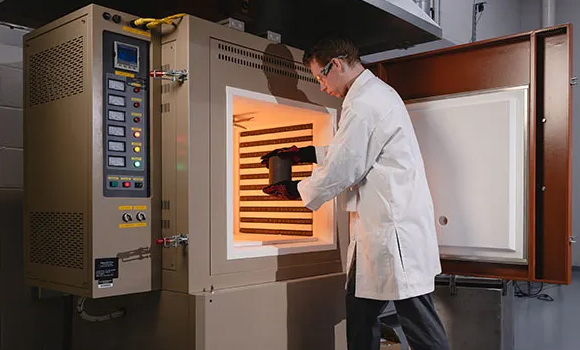
Dark ceramics are ideal materials for hypersonic vehicle components because they’re less likely to crack or degrade due to extreme atmospheric conditions. To manufacture these ceramic components, Trice and his team utilize Additive Manufacturing machines at HAMTC, which employ a process known as digital light processing. These machines are equipped with a projector that shines ultraviolet light onto a thin layer of slurry made up of ceramic powder and resin. The UV light then cures or hardens that layer, securely locking the powder in place.
According to Trice, the component is constructed layer by layer using digital light processing. “This allows you to produce intricate designs and geometries with very smooth surfaces and with a level of precision at the micron level,” he shared. “Through this process, we have succeeded in printing a variety of shapes, such as sharp cones and hemispheres, which are used to build a hypersonic vehicle.”

The challenge of Additive Manufacturing dark ceramics comes from the way their colour interacts with the UV light the AM machine projects. A light-coloured ceramic, such as alumina, will reflect and scatter the light, hardening the entire layer at once. Dark ceramics, however, tend to absorb that light and, therefore, inhibit the curing process.
“Because dark powders absorb the UV light that would be necessary to cure the material, we cannot form as thick of a layer,” said Trice. “Therefore, we get cure depths that are too thin, which then negatively impacts the time it takes to build each part.”
Matthew Thompson, a materials engineering doctoral candidate and recipient of a National Defense Science and Engineering Graduate Fellowship, and Dylan Crump, a ceramics research engineer at HAMTC, have been working with Trice to investigate resin systems, surface treatments and other approaches to increase the cure depths.
“We’ve been operating essentially as a research and development test bed for these materials,” Thompson shared. “We’ve been tuning properties and performing surface modifications to improve their performance and enhance the printing process.”
Trice, Thompson, and Crump are working to resolve issues that occur during the post-processing phase, which becomes increasingly challenging as the size of additively manufactured parts grows. When dealing with larger components, there is an increased risk of issues such as delamination, which involves the layers of the part peeling or separating, and cracking. It is important to address these risks to ensure that they do not compromise components during the transition from a small-scale machine to a larger one.
“What we’re trying to do is find solutions for how we can either set up a pipeline to make these parts or find strategies that actual stakeholders can use,” Thompson added. “So, it gives people a starting point to save time on the research and development for any new system.”
This effort is one of five projects funded by the Office of the Secretary of Defense Manufacturing Science and Technology Program, partnering with the Naval Surface Warfare Center, Crane Division, and the National Security Technology Accelerator’s Strategic and Spectrum Missions Advanced Resilient Trusted Systems.
www.purdue.edu