

Nivalon additively manufactures metal-free ceramic spinal implants
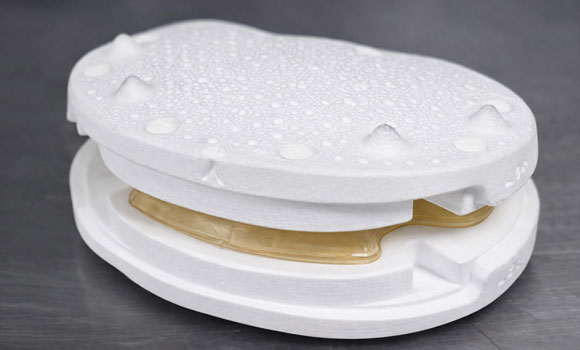
Nivalon Medical Technologies Inc., Youngstown, Ohio, USA, has produced what it states is the world’s first fully patient-specific, motion-preserving spinal implant, developed from AI-driven design and additively manufactured ceramic, without the use of any metal.

The EvoFlex device combines a proprietary zirconia-toughened alumina (ZTA) ceramic architecture that is said to behave like bone, with a flexible elastomeric core mimicking natural spinal motion. The company stated that this development creates a new category of spinal implant engineered to match both human anatomy and natural biomechanics.
The development of its EvoFlex was achieved through a strategic collaboration with the Youngstown Business Incubator and its Advanced Manufacturing and Engine Tech programmes. Using XJet’s NanoParticle Jetting Binder Jetting Additive Manufacturing technology, Nivalon successfully developed and manufactured a pure ceramic, load-bearing spinal implant architecture.
SEM analysis at UConn stated that the additively manufactured ZTA ceramic represents a new and distinct microstructural class of biocompatible implant material.
Patient-specific implants
Unlike traditional implants manufactured in fixed sizes and made from metal alloys, Nivalon’s implant is digitally designed directly from each patient’s CT data and additively manufactured to precisely match their anatomy. The result is a ceramic structure that is said to eliminate metal-related complications such as corrosion, ion release, stiffness mismatch, and imaging interference, while preserving natural spinal motion.
“I realised the problem wasn’t the surgeons – it was the implants,” stated Todd Hodrinsky, Nivalon co-founder and CEO. “We were trying to treat a living biological structure with industrial metal hardware that was never designed to behave like bone or properly follow natural spinal motion. We knew we could engineer something fundamentally better.”
Clinical validation
The platform has undergone extensive independent pre-clinical validation through biomechanical, mechanical, biological, and anatomical testing conducted at the University of South Florida (USF) and the University of Connecticut Institute of Materials Science (UConn IMS).
At USF, EvoFlex implants were evaluated on the Dynamic Investigation of Spine Characteristics (DISC) simulator under 6º of freedom motion and physiologic spinal loading, demonstrating stiffness curves and motion profiles that closely replicate native human spinal behaviour. These results report true motion preservation, not just mechanical articulation.
At UConn IMS, compression and shear testing demonstrated major improvements in structural performance. The latest design achieved compressive loads of 14.6 kN, equivalent to approximately 1,490 kg (3,280 lbs) of force, validating the ceramic-polymer architecture under physiologic and supraphysiologic loading. Shear testing further demonstrated enhanced interface integrity and controlled progressive failure behaviour.
UConn IMS also conducted simulated body fluid (SBF) immersion and SEM-EDX analysis, reporting that ZTA ceramic supports uniform mineral deposition and biologically relevant ion interaction, demonstrating bone-like surface behaviour and long-term osseointegration potential. Unlike metals, the ceramic showed consistent, controlled, and predictable biological interaction.
This prototype represents the transition from research into scalable clinical manufacturing. With two issued US patents and six additional patents pending, Nivalon is preparing for NIH Phase II SBIR funding, FDA PMA clinical trials.