

Nanoe to debut ultra-high-temperature ceramic composite and corrosion-resistant filaments at Formnext 2025

At Formnext 2025, Nanoe, headquartered in Ballainvilliers, France, will debut an ultra-high-temperature ceramic (UHTC) composite, consisting of zirconium diboride (ZrB₂) and silicon carbide (SiC). The material will be available in powder form for pressing and injection molding, as well as in filament form for Additive Manufacturing.

Nanoe will also showcase its collaboration with French nuclear group Orano on anti-corrosion materials. This partnership has resulted in the development of 304L and Monel 400 Zetamix filaments.
Ultra-high-temperature ceramic composite
“UHTC ceramics have been the subject of extensive research in recent years, particularly with a view to developing materials capable of withstanding hypersonic conditions,” stated Guillaume de Calan, CEO of Nanoe. “However, the market has so far lacked ready-to-use commercial products, without which industrial applications cannot emerge. That’s why we’re launching both a powder for traditional processes like pressing, and a filament for 3D printing.”
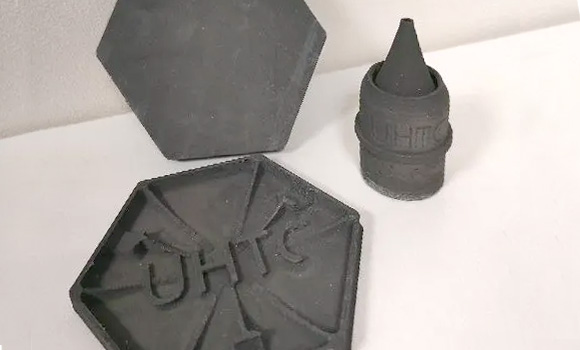
Nanoe’s new UHTC composite consists mainly of ZrB₂ (80%) and SiC (20%), with additional doping elements including B₄C. This enables pressureless sintering at 2,000°C under partial argon pressure.
Guillaume Bouchet Doumenq, CTO of Nanoe, adds: “One commonly accepted limitation of UHTCs is the need for pressure-assisted sintering. While pressure sintering often results in better densities, it significantly restricts the geometry of the parts. Our work on material formulation and preparation has enabled us to achieve a dense material through conventional sintering, with parts that are either cold-pressed or 3D printed.”
The first customers for this material are said to include laboratories working in aerospace and defence, such as NASA and ONERA, as well as a ‘New Space’ startup and a major European defence contractor.
Anti-corrosion materials
Monel is a nickel-copper alloy already widely used by Orano in the nuclear fuel electrolysis process. Taking place under extreme conditions of temperature and corrosion, this process requires specially adapted materials. The ability to additively manufacture these materials will enable the production of spare parts, R&D assemblies and other small components necessary to the electrolytic process. Nanoe and Orano therefore worked together to develop a custom Monel filament.

Jeremy Paul-Joseph, Head of 3D Printing Activities at Orano Tricastin, stated, “The ability to 3D print components directly in Monel opens up very interesting opportunities for Orano, both for prototyping, test bench manufacturing, and eventually for maintenance. The Nanoe–Orano partnership is a true catalyst for feasibility studies involving specific alloys, with controlled costs and lead times compared to other Additive Manufacturing technologies.”
For less critical applications, the companies also developed a 304L filament. Initially, this will be used to manufacture small tanks for R&D assemblies to simulate the industrial process in a laboratory environment.
“One of the main advantages of our Zetamix 3D printing technology is its ability to print a wide range of materials,” de Calan explained. “We are very pleased to have been able to apply our skills and know-how to serve the French nuclear industry, which specifically requires dedicated material, whether metals or ceramics such as SiC. This is a great example of the kind of collaboration we can establish with industrial partners, thanks to our ‘Zetamix on demand’ offer.”