

HRL leverages Additive Manufacturing to produce defect-free ceramic composites
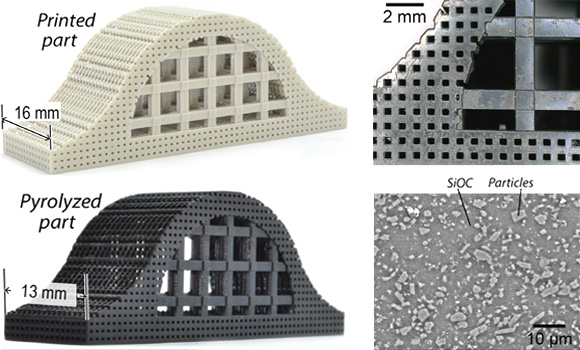
Jointly owned by General Motors and Boeing, HRL Laboratories, Malibu, California, USA, has leveraged high-resolution Additive Manufacturing technology from Prodways, Montigny-le-Bretonneux, France, to support its research into polymer-derived ceramics (PDCs).
PDCs are a class of materials that begin as liquid polymers and, through high-temperature pyrolysis, are transformed into advanced ceramics. This route allows engineers to shape complex components using Additive Manufacturing before converting them into lightweight, heat-resistant, and durable ceramics.
Increasingly, PDCs are finding use in aerospace, energy, and defence applications where extreme environments demand materials that combine design flexibility with outstanding performance. This shaping method may remove limitations associated with other Additive Manufacturing methods – in particular, the binder burn-out and sintering-associated engineering challenges.

Using the ProMaker L5000 digital light projection AM machine, HRL demonstrated that precise control over reinforcement size and distribution is critical to manufacturing fully densified silicon-oxycarbide ceramics. Of note was the fact that small particles can strengthen the ceramic without defects, while oversized inclusions can trigger microcracks during conversion.
HRL has reported that these findings point to a clear path forward: by optimising resin formulations and reinforcement geometries, Additive Manufacturing can deliver tough, defect-free ceramic components directly from polymer precursors. As well as confirming the feasibility of producing high-performance ceramic matrix composites by Additive Manufacturing, HRL states that the research also provides insight into guiding future aerospace- and defence-grade applications.
This work builds on research conducted by HRL Laboratories published as ‘Reinforcement Induced Microcracking During the Conversion of Polymer-Derived Ceramics’ in Acta Materialia.