

Corrosion resistance of MIM 316L and 904L stainless steel watch links in contact with human skin

Stainless steel parts produced by Metal Injection Moulding find extensive application in medical instruments, dental orthodontic brackets, electronic devices, consumer products, automotive components, wristwatch parts such as cases and bracelets, and many more. 316L austenitic stainless steel is a grade commonly used for the above sectors with the primary alloying constituents after iron being Cr (16-18%), Ni (10-12%) Mo (2-3%) and up to 2% Mn, giving this grade excellent corrosion resistance and also high yield and tensile strength similar to conventional 316L grade. 904L is also an austenitic stainless steel grade but its higher contents of Ni (24-26%), Cr (19-21%), Mo (4-5%) and Cu addition (1-2%) gives this grade superior corrosion resistance in extremely corrosive environments.
Watchmakers have traditionally produced 316L and 904L stainless steel bracelet parts such as links by machining drawn metal profiles. However, the MIM process has, in recent decades, been found to be a less expensive manufacturing process and a number of watch producers now routinely use the MIM process to produce both bracelet links and watch cases from these grades of stainless steel.
One of the drawbacks of using 316L and 904L grades stainless steel is in applications where the alloy parts, which contain high amounts of Ni, come into contact with human skin causing skin sensitivity. Nickel is said to be the most widespread cause of all contact allergies with an estimated 10–15% of adult females and 1–3% of adult males in Europe being allergic to nickel. Of nickel-sensitive people in the general population, 30% develop hand eczema. The role of nickel in the biological response to 316L alloys used in medical devices, implants and orthodontic dental brackets is also of significant concern regarding toxicology and biological performance.
There are two European Union Directives: 94/27/CE and 2004/96/ that regulate the use of nickel in jewellery and other products that come into contact with the skin. Since June 2009 these Directives have been subsumed into Annex XVII of the REACH Regulation which outlines the restrictions on the ‘manufacture, placing on the market and use of certain dangerous substances, mixtures and articles’. It is stated in REACH that Ni-containing alloys cannot be used in articles intended to come into direct and prolonged contact with the skin, such as wristwatch cases, watch straps and tighteners and other products if the rate of nickel release from the parts of these articles coming into direct and prolonged contact with the skin is greater than 0.5 µg/cm2/week. Thus, in the manufacture of bracelets and other articles specific to watches, there is now a trend of replacing Ni containing stainless steel grades with nickel-free austenitic steels.
A research group based in Marin-Epargnier and Neuchâtel, Switzerland, and Saint-Laurent-du-Pont, France, was requested by a Swiss watchmaking group to carry out an in-depth study of the corrosion behaviour of a number of 316L and 904L stainless steels obtained by MIM and MIM + HIP using different electrochemical techniques. Conventional stainless steels of the same austenitic grades were also tested using the same techniques. In the manufacture of bracelets in link and pin assembly, galvanic currents can be generated by the presence of sweat or other aqueous electrolytes (sea water, swimming pool water, rain or condensation of atmospheric humidity). For this reason, direct measurements of the galvanic couplings between MIM alloys and conventional stainless steels were carried out. The pitting potential of these alloys was also evaluated by applying the ASTM G48-11 standard for ferric chloride.
The results of this in-depth study were published in the paper, ‘Evaluation of the Corrosion Resistance of Watch Links from 316L and 904L Austenitic Stainless Steels Obtained by the Metal Injection Moulding (MIM) Technique Intended to Be in Contact with Human Skin’, by the authors Lucien Reclaru, Florina Ionescu and Frederic Diologent, in the journal Coatings Vol. 14, 412, March 30, 2024. 28 pp.
The study involved testing ten MIM samples in the form of 10 mm diameter mirror polished discs – six 316L samples from one supplier, and two of each grade 904L and 316L from a second supplier. Table 1 lists the samples and the manufacturing conditions used including green and milled discs, short and long sintering cycles and any post sintering HIP operation. For comparison, a complementary study was conducted on 316L and 904L bulk alloys.
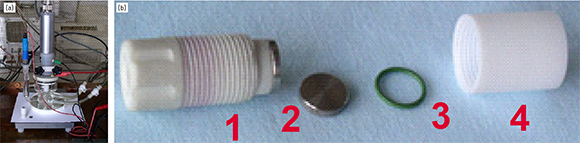
The authors reported that the evaluation of corrosion resistance of the ten MIM alloys (eight samples of MIM type 316L and two samples of MIM type 904L) was done using electrochemical techniques, rotating electrodes and galvanic coupling (Fig. 1). Different electrochemical parameters were measured and calculated (the open circuit potential, the polarisation resistance, the corrosion current and Tafel slopes, the coulometric analysis and galvanic coupling current). Tests to evaluate the resistance of the MIM 316L and 904L stainless steels to pitting corrosion in a ferric chloride medium and the measure of the released nickel cations were also completed in this study. The authors concluded that if the MIM stainless steels studied are compared with conventional bulk stainless steels, then their corrosion resistance behaviour is inferior (Fig. 2).
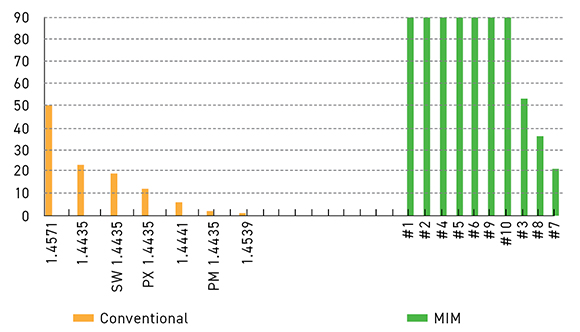
In the couplings studied, the galvanic currents generated are very important. The shape of the curves also reveals the presence of localised corrosion phenomena. According to tests in ferric chloride, MIM stainless steels were noted to have inferior behaviour compared to conventional stainless steels (Fig. 3). However, MIM type 904L stainless steels are comparable in behaviour to conventional type 316L steels. The quantities of nickel released according to EN 1811 were very significant (2 mg cm−2 week−1 up to 24 mg cm−2 week−1), and did not meet the requirements of the European Directive (0.5 µg cm−2 week−1).
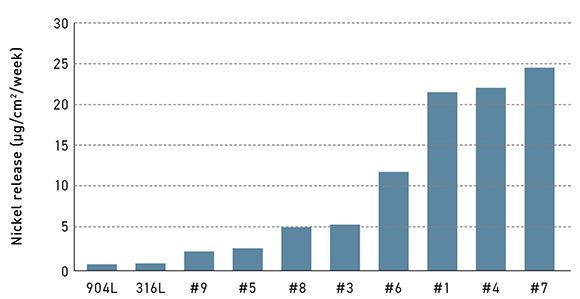
The authors stated that the parameters studied to characterise corrosion behaviour of the two MIM austenitic stainless steels did not reveal any correlation with the manufacturing parameters proposed as technological criteria. They concluded that there is a strong trend of developing nickel-free austenitic stainless steels which adhere to the EU and ASTM standards for medical and other applications such as watch components, and they believe these alloys could also be used in the MIM industry for articles in contact with the human body.