

Continuum Powders releases M247 Ni superalloy for Binder Jetting
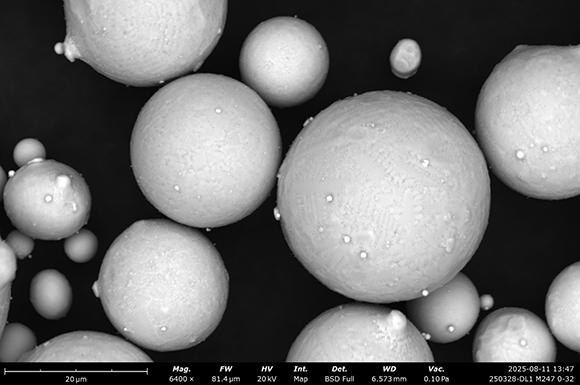
Continuum Powders, based in Houston, Texas, USA, has announced the commercial availability of its OptiPowder M247 and M247LC nickel superalloy powders, providing users with a high-performance alloy historically limited to investment casting. By optimising M247 for Binder Jetting and other non-PBF-LB Additive Manufacturing platforms, Continuum is enabling engineers to leverage its high-temperature performance without the long lead times and tooling costs of traditional casting.

M247 is a precipitation-hardenable, nickel-based superalloy engineered for service in extreme environments. It offers superior creep resistance, thermal stability, and oxidation resistance at temperatures up to 980°C (1800°F), making it ideal for hot-section components in gas turbine engines and power systems.
“Mar-M247 has always been a powerful material—but it’s been locked behind slow, expensive casting for too long,” stated Rob Higby, Chief Executive Officer at Continuum Powders. “By offering OptiPowder M247, a binder-jet-ready version made from certified aerospace scrap, we’re giving manufacturers a faster, more flexible, and ESG-aligned alternative—while maintaining the mechanical strength and consistency they depend on.”
Through its proprietary Melt-to-Powder (M2P) process, Continuum transforms high-value reclaimed aerospace-grade scrap into powder that meets stringent cleanliness and particle morphology standards. The process preserves alloy integrity while minimising oxygen pickup, ensuring consistent performance across multiple builds.
“Our M247 offering changes the economics and accessibility of this alloy for advanced manufacturing,” added Sunil Badwe, Vice President of Technology at Continuum Powders. “We’ve qualified specific powder recipes for leading binder jetting platforms, enabling OEMs to produce complex geometries and consolidated assemblies that were previously impractical with casting. These powders can also be adapted for other Powder Metallurgy routes, from Metal Injection Molding (MIM) to Hot Isostatic Pressing (HIP) of near-net shapes.”