

Ceramic AM study reports ultralow shrinkage
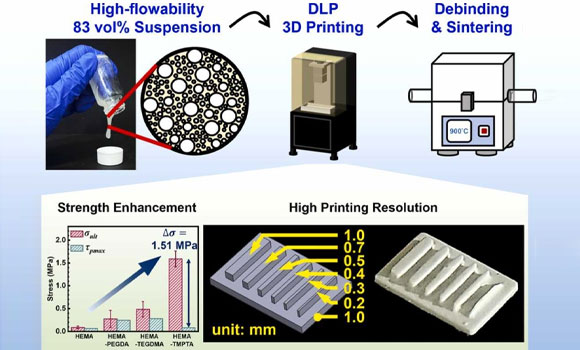
Researchers from the National Taiwan University, Taipei, have published research in Additive Manufacturing focused on the development of a flowable suspension for ceramic Additive Manufacturing that reportedly produces components with low shrinkage and nearly full density.
While Vat Photopolymerisation (VPP) Additive Manufacturing may expand the use of ceramics in manufacturing, the resultant properties are often not suitable for high-precision components due to high shrinkage during sintering and insufficient density.
In ‘Ultralow-shrinkage ceramic fabrication via three-dimensional printing of high-solid-loading suspensions’, the researchers formulated ultrahigh-solid-loading suspensions containing silica up to 83.0 vol% with superior flowability (<50 Pa.s). A systematic optimisation of suspension composition was established, integrating Hansen solubility parameters (HSP), a viscosity model, and the Scott equation. HSP guides the enhancement of particle-resin compatibility to maximise solid loading, while the viscosity model predicts optimal particle size distribution for minimised viscosity at 83.0 vol% loading.
Despite the extremely limited resin matrix, the researchers stated that TMPTA reinforcement effectively increased the tensile strength of green parts beyond the viscous peel stress. The critical issue of negative curing width and excessive curing depth in ultrahigh-solid-loading suspensions was mitigated by introducing 1.60 wt% UV-absorber, which reduced curing depth at the width-critical energy dose and enabled fine-feature Additive Manufacturing with low dimensional deviation (<6 %).
The optimised 83 vol% suspension was noted to have achieved the sintered ceramics with ultralow isotropic volumetric shrinkage (<6.5 %) and nearly full densification (∼100% relative density). The resulting ceramic air penetrator reportedly retained intricate architectures with high fidelity and dense microstructures.
The paper is available here.