

Bosch reaches one billion Metal Injection Moulding parts at Immenstadt facility

Robert Bosch GmbH has achieved a significant milestone at its manufacturing facility in Immenstadt im Allgäu, Germany. The company reports that, since the start of series production in 2006, one billion components have been manufactured at the site via Metal Injection Moulding.
Markus Gorbach, Production Department Manager at Bosch, stated, “MIM combines the precision of plastic injection moulding with the strength of metal components. It is a technology that has opened up new possibilities for producing high-volume, precision parts that would be difficult to produce with conventional methods due to their complex geometries. With a single shot into an injection mould and the subsequent processing chain, extremely precise components are created for the most demanding applications – this is the unique advantage of MIM.”
Insight into the Immenstadt MIM operation
Commenting on Bosch’s Immenstadt operation, Rainer Gumpinger, Manufacturing Engineering and Operations, Power Solutions, told PIM International, “We produce our feedstock entirely in-house. This is a key element of maintaining our quality standards. Our customer complaint rate is extremely low – truly best in class.”
Gumpinger also pointed to downstream processing and inspection as differentiators, stating, “What sets us apart are our in-house hardening processes, where we consistently achieve superior hardness levels and microstructures. Additionally, our visual inspection is fully automated.” Discussing materials selection and sintering strategy, Gumpinger explained, “We process a broad range of alloys, from Bosch-patented stainless steels to soft magnetic materials, tool steels, and other standard MIM alloys. Similar to most high-volume MIM manufacturers – nothing too exotic.”
“Our components achieve the best results with batch sintering; continuous furnaces are more challenging to control at the precision levels required. Still, we look into that for some new projects.”
Depending on component requirements, targeted post-processing steps are undertaken, including diffusion annealing, coining, hardening, grinding, finishing and automated visual inspection. Gumpinger said, “We also operate an in-house tool shop (tool engineering and manufacturing), which is standard practice in the industry.”
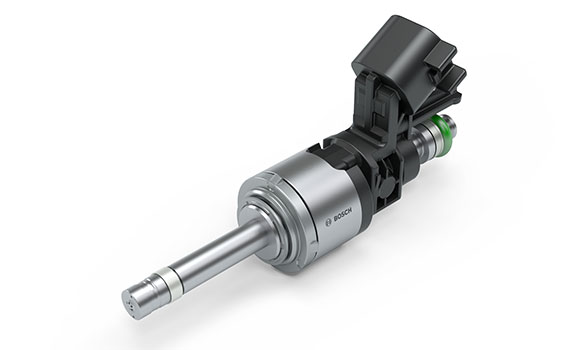
High-volume application insight: the multi-hole valve for gasoline direct injection (GDI)
The application areas for MIM at Bosch include the automotive, consumer goods, industrial technology and medical technology sectors. A key example is the multi-hole valve (MLV), which Bosch says accounts for a significant proportion of the MIM components manufactured. The valve is used in gasoline direct injection systems. According to Bosch, the component withstands pressures up to 500 bar and supports clean, efficient fuel combustion.
Gumpinger described the MLV as “a very small but highly complex component with multiple integrated functionalities.” He added, “The part’s weight is below 1 g, and for the sealing area, we reliably achieve tolerances of approximately 1 µm, enabled by several proprietary in-house processes.”
An evolving MIM strategy
Bosch positions MIM as a long-term part of its manufacturing strategy. While the internal combustion engine (ICE) is undergoing structural change in some regions, the company expects demand for gasoline direct injection components to persist in markets such as Asia, Africa, South America and Australia beyond 2035.
At the same time, Bosch says it is expanding MIM into non-ICE programmes through both internal development and external projects. Current developments and pilot phases cited by the company include components for braking systems, parts for hydrogen technology, precision instruments in the medical sector and tools made from high-strength materials. Gorbach said, “We are investing specifically in future-oriented technologies and new markets to remain successful at the location in the long term.”
Notably, the company is expanding its offering as a MIM parts supplier to third parties, leveraging expertise developed over nearly two decades of production. Gorbach stated, “The majority of our MIM components are supplied within Bosch. However, we are increasingly focusing on external customers to further diversify our business.”
Binder Jetting for prototypes and selected series parts
Alongside MIM, Bosch also highlighted Additive Manufacturing routes for speed and selected series production. “For prototypes, we offer fast-turn capability through AM technologies including Binder Jetting and Vat Photopolymerisation (VPP). As well as prototype parts, these can also be used for prototype tooling,” Gorbach said.
Beyond prototyping, Gumpinger added, “We also manufacture selected series parts – both for internal Bosch applications and external customers – using Binder Jetting. We use machines from Digital Metal, now part of Markforged, which are still among the most capable available – true workhorses that deliver the highest quality components.”
Achieving one billion MIM components at Bosch’s Immenstadt site illustrates the industrial maturity and scalability of Metal Injection Moulding. Bosch says this reflects its ability to manage complex process chains for high-volume, technically demanding applications, while expanding into additional application areas and markets.