

Bosch Advanced Ceramics takes advantage of ceramic AM for complex medical insulating sleeve production

ApplicationsNews
October 25, 2024
Bosch Advanced Ceramics has produced a ceramic insulating sleeve for a laparoscopic tool used in minimally invasive surgery (Courtesy Bosch Advanced Ceramics)

Bosch Advanced Ceramics has reported the successful Additive Manufacturing of a ceramic insulating sleeve for a laparoscopic tool used in minimally invasive surgery. A standout achievement in the project was said to be the ability to manufacture 1,400 parts in a single batch, demonstrating both the precision and scalability of the process.

The team started with the challenge of producing a component with a maximum external diameter of 1.3 mm and a wall thickness of just 90 µm. The part’s small size and complexity were critical for its function as an electrical insulator within the medical device.

TRUSTED BY INDUSTRY’S BIGGEST NAMES
Discover how we help leading brands shape the industry conversation
Contact us

Using Lithography-based Ceramic Manufacturing (LCM) technology, a form of Vat Photopolymerisation Additive Manufacturing from Lithoz GmbH in Vienna, Austria, Bosch Advanced Ceramics was able to ensure exceptional precision and design flexibility. This level of detail would be impossible with conventional manufacturing processes.

The development process for the insulating sleeve required several design iterations to balance structural integrity with electrical insulation properties. The AM technology used allowed Bosch Advanced Ceramics to make rapid adjustments to the design and process parameters, enabling them to fine-tune the manufacturing approach. Each version of the part underwent rigorous testing, and four iterations were tested to achieve the optimal wall thickness and external diameter.

By leveraging the 40 µm resolution of Lithoz’s CeraFab machine, Bosch Advanced Ceramics could consistently produce parts with the required 90 µm wall thickness. This was a key factor in the component’s performance, as it had to fit within the confines of a laparoscopic tool and provide insulation between two conductive components.

The ceramic component is an insulating sleeve with an outer diameter of 1.3 mm and a wall thickness of just 90 µm. The small size and complexity of the part is critical to its function as an electrical insulator within the medical device (Courtesy Bosch Advanced Ceramics)

Bosch Advanced Ceramics used LithaLox 360 alumina, a material offering excellent thermal resistance, chemical stability, and electrical insulation. These properties were crucial for the component’s performance in the demanding conditions of surgical sterilisation and use.

Following a successful sample phase, Bosch Advanced Ceramics began scaling up production. The ability to produce 1,400 parts per batch on a single build plate allowed Bosch Advanced Ceramics to rapidly meet the customer’s demand, set at 20,000 parts per year.

A critical factor in this achievement was also reported to be Bosch Advanced Ceramics’ proprietary cleaning process, which allowed for gentle and effective handling of the fragile green parts post-build. This automated process ensured that excess material was removed without damaging the delicate structures, maintaining the quality and consistency of each batch.

For more detailed insights into this project, read the full article in PIM International’s Autumn 2024 edition, here.

www.bosch-advanced-ceramics.com
GET THIS ISSUE:  PDF  |  VIEW ONLINE  |  BUYER’S GUIDE
ApplicationsNews
October 25, 2024

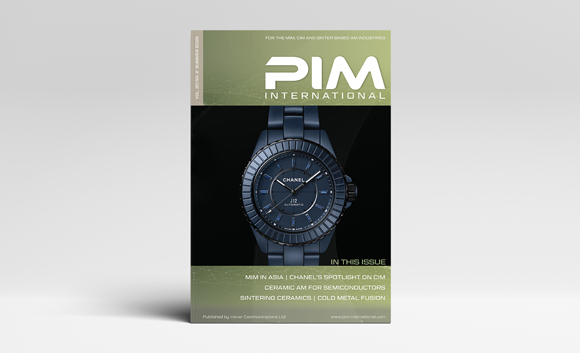
In the latest issue of PIM International…

Download PDF

Extensive MIM, CIM industry and sinter-based AM industry news, plus the following exclusive deep-dive articles and reports:

  • Element 22: Mastering titanium component production with Metal Injection Moulding and Additive Manufacturing
  • Advancing industrialisation: Binder Jetting at the forefront of a maturing sinter-based AM landscape
  • Tailored feedstocks for MIM, CIM and sinter-based AM: How Blesol Tech is responding to market requirements
  • Cleaner semiconductor etching: Bosch Advanced Ceramics’ two-part AM injector produced with Lithoz technology

Buyer’s Guide: feedstock, powder, production technology and MIM, CIM and AM parts

Discover suppliers of these and more in our advertisers’ index and buyer’s guide, available in the back of PIM International.

  • Metal powders
  • MIM, CIM & AM parts producers
  • Binders & feedstocks
  • Feedstock mixers
  • Furnaces & furnace supplies
  • Atmospheres & gas generation
  • HIP systems & services
  • Injection moulding machines
  • AM technology
  • Debinding systems
View online

Register for our fortnightly newsletter

Don't miss any new issue of PIM International, and stay up to date with the latest industry news. Sign up to our fortnightly newsletter.

Sign up

Join our community

Discover our magazine archive…

The free-to-access PIM International magazine archive offers unparalleled insight into the world of MIM, CIM and sinter-based AM from a commercial and technological perspective through:

  • Reports on visits to leading part manufacturers and industry suppliers
  • Articles on technology and application trends
  • Information on materials developments
  • Reviews of key technical presentations from the international conference circuit
  • International industry news

All past issues are available to download as free PDFs or view in your browser.


Browse the archive


Share via
Copy link
Powered by Social Snap