

Binder Jetting advances SiC optical mirror production
Researchers from the Chinese Academy of Sciences have published research in Light: Advanced Manufacturing focusing on the production of high-performance silicon carbide optical mirrors via Binder Jetting (BJT) Additive Manufacturing.

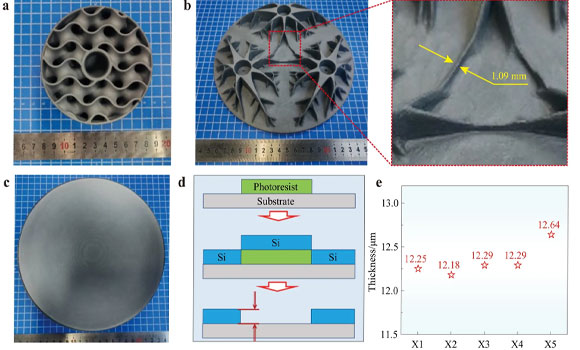
Silicon carbide (SiC) is widely regarded as a leading material for high-performance space optical mirrors due to its high specific stiffness, low coefficient of thermal expansion, and high thermal conductivity. However, as optical systems increasingly demand lightweight and complex geometries – including triply periodic minimal surface (TPMS), topology-optimised, and lattice structures – conventional manufacturing methods such as pressure moulding and slip casting have struggled to realise these designs.
Additive Manufacturing may offer a route to producing complex ceramic structures without the need for tooling or extensive machining. For SiC mirrors, this typically involves producing a porous preform that is subsequently densified through reactive melt infiltration (RMI), resulting in Si/SiC composites.
Among Additive Manufacturing technologies explored for this application – including Vat Photopolymerisation, Powder Bed Fusion (PBF), Material Extrusion (MEX), and Binder Jetting (BJT) – each presents trade-offs. Vat Photopolymerisation enables high precision, but requires improved material performance; PBF can introduce deformation due to rapid thermal cycling. MEX offers good material properties but is limited in geometric complexity. BJT, by contrast, provides high efficiency and design freedom, but challenges remain around high porosity and residual silicon content after infiltration, which can degrade mechanical performance.
To address these limitations, the researchers investigated composite powder optimisation strategies to improve the properties of BJT Si/SiC. A key focus was reducing residual silicon by enhancing carbon content within the preform. While carbon precursor infiltration and pyrolysis (CPIP) has previously been used to achieve this, large pore sizes in BJT parts can lead to incomplete reactions and residual carbon, negatively impacting optical performance.
In ‘Binder jetting additive manufacturing of high-performance silicon carbide optical mirrors via graphite addition method’, the researchers introduced a graphite addition approach, incorporating various forms of graphite – including nanoscale, microscale, flake, and fibre – into the SiC powder feedstock. Graphite served a dual role: improving powder flowability during the BJT Additive Manufacturing process and acting as a carbon source to promote conversion of residual silicon into secondary SiC during RMI.
Among the graphite types evaluated, flake graphite proved most effective, reportedly reducing the Carr index of the powder from 39.14% to 31.29% and increasing preform density from 1.24 g/cm³ to 1.34 g/cm³. This improved homogeneity and enabled more complete reactions during infiltration. As a result, residual silicon content decreased by 18.18%, while overall density increased by nearly 6%.
Mechanical and thermal properties also improved, with flexural strength reaching a reported 268 MPa, elastic modulus 330 GPa, and thermal conductivity 127 W/(m·K). Optical testing of fabricated mirrors with complex geometries demonstrated surface roughness of 0.772 nm RMS and shape accuracy of 12.05 nm RMS following finishing, indicating suitability for high-performance optical applications.
According to the researchers, this study further demonstrated that the Binder Jetting and RMI process chain offers strong dimensional control, with deviations below 0.5% and consistent porosity levels across samples. The paper concluded that the approach represents a viable near-net-shape manufacturing route for Si/SiC optical mirrors, combining geometric flexibility with improved material performance for advanced optical systems.
‘Binder jetting additive manufacturing of high-performance silicon carbide optical mirrors via graphite addition method’ is available here.