

Exploring MIM market dynamics: Highlights from the World PM2024 Congress, Yokohama
The 2024 Powder Metallurgy World Congress in Yokohama, Japan, offered an opportunity for the Metal Injection Moulding industry to come together, share market data, and explore emerging trends. The event addressed key issues such as declining sales in major regions, shifts in material demand, and the broader economic and geopolitical challenges affecting the industry. Attendees also explored strategies for innovation, market diversification, and sustainability to drive future growth. Nick Williams shares key data and insight from this important global industry event. [First published in PIM International Vol. 18 No. 4, Winter 2024 | 10 minute read | View on Issuu | Download PDF]
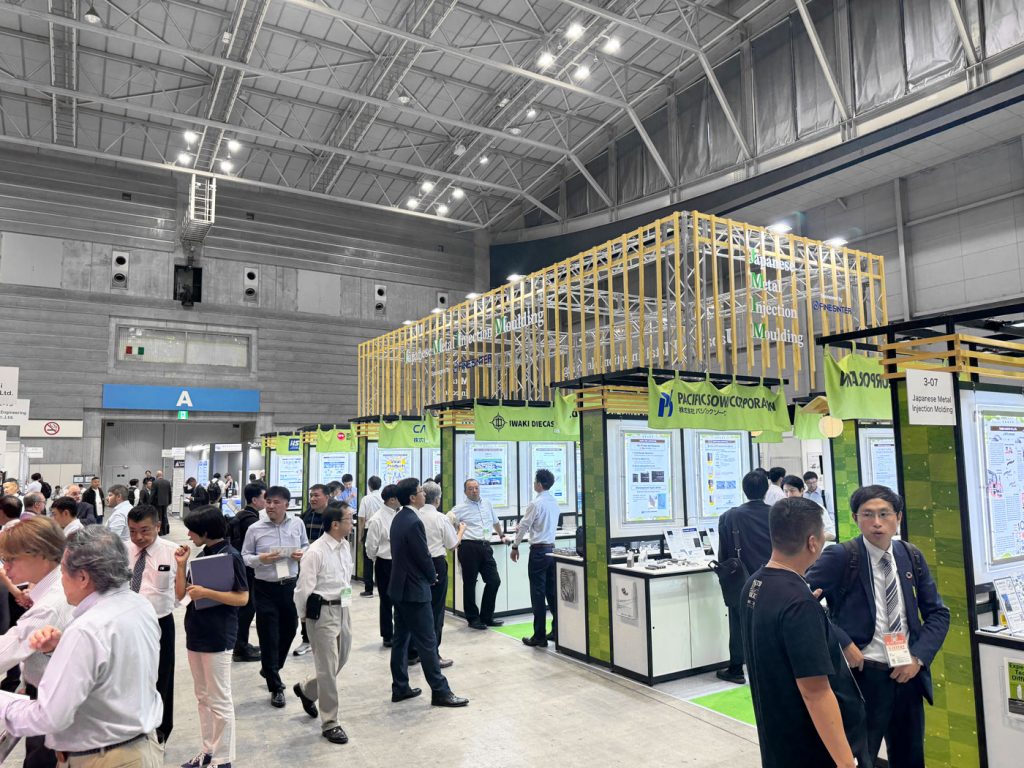
After a twelve-year gap, the Powder Metallurgy World Congress series returned to Yokohama, Japan, from October 13-17. Organised by the Japan Powder Metallurgy Association (JPMA) and the Japan Society of Powder and Powder Metallurgy (JSPM), under the auspices of the Asian Powder Metallurgy Association (APMA), the event attracted nearly 800 congress delegates from twenty-seven countries, alongside numerous additional visitors to the exhibition.
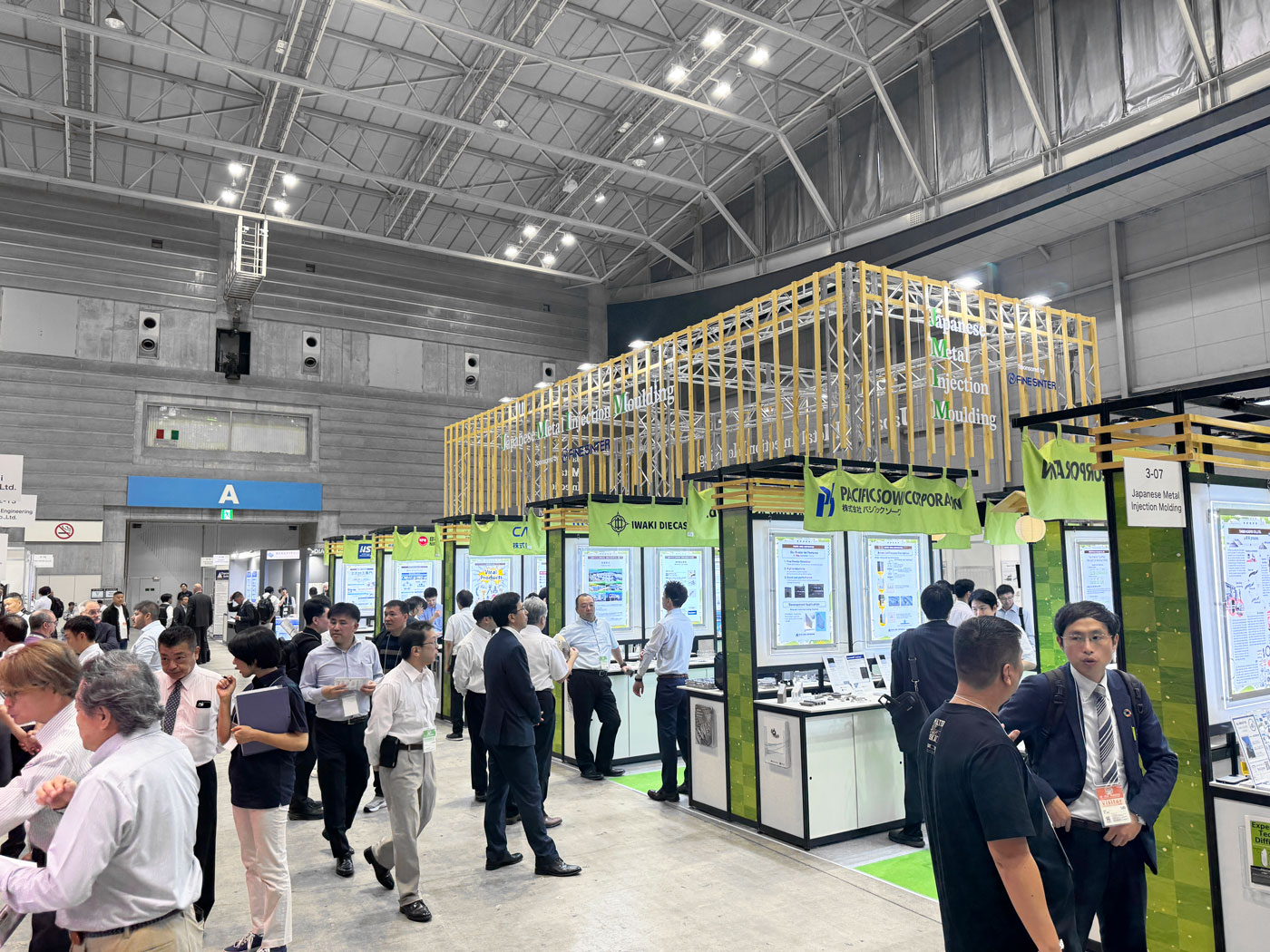
Whilst MIM technology was prominently featured throughout World PM2024’s comprehensive technical programme, the Japanese Metal Injection Moulding pavilion in the World PM2024 exhibition hall stood out as a particular highlight (Fig. 1). The pavilion featured fourteen Japanese companies, each engaged in either MIM production or the provision of materials and technology to the MIM sector. Partners in the pavilion were atect Corporation, Castem Co Ltd, Iwaki Diecast Co Ltd, Juki Aizu Corporation, Nakahara Precision Co Ltd, Nippon Piston Ring Co Ltd, Oriental Chain Mfg Co Ltd, Osaka Titanium Technologies Co Ltd, Osaka Yakin Kogyo Co Ltd, Pacific Sowa Corporation, Repton Co Ltd, Taisei Kogyo Co Ltd, Teibow Co Ltd, and Toko Tsusho Corporation.
The MIM industry meets at a time of stalling growth
World PM2024 took place at a time when MIM industry growth appears to be stalling in many regions. In the case of Japan, evidence for this comes from the JPMA’s recently published MIM industry statistics. The data – covering 2023 – was provided by eighteen MIM part-producing companies, including members and non-members of the JPMA.
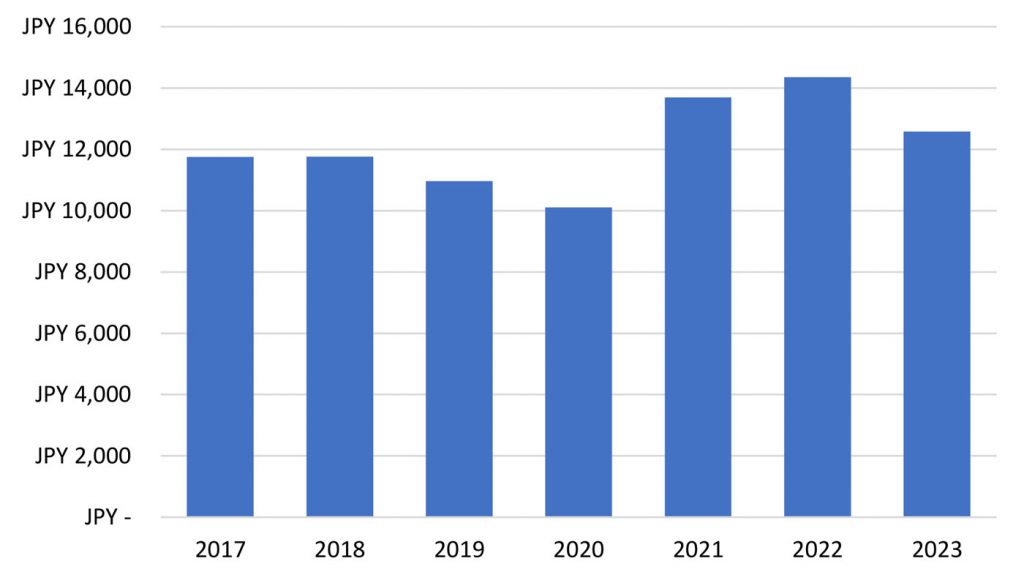
Total sales of MIM parts by Japanese producers for 2023 were reported as ¥12.581 billion ($82.444 million), a 13% decrease from the previous year’s ¥14.35 billion. Fig. 2 shows Japanese MIM parts production by sales value, from 2016 to 2023. No specific reason was given for the reduction in sales in the data’s source, ‘2023 Report for MIM Market’, and no individual markets can be identified as showing significant changes (Fig. 3), so the sales reduction has to be attributed to the overall business climate, which has been impacted by a challenging economic and geopolitical environment worldwide.
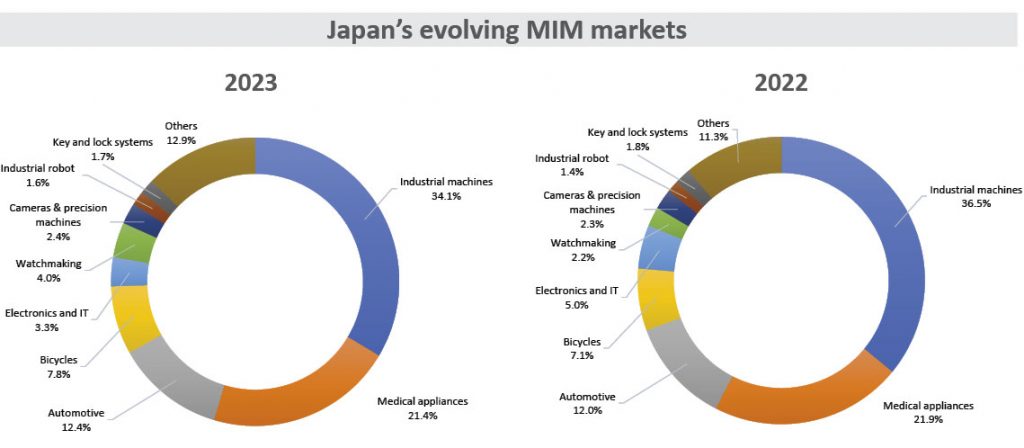
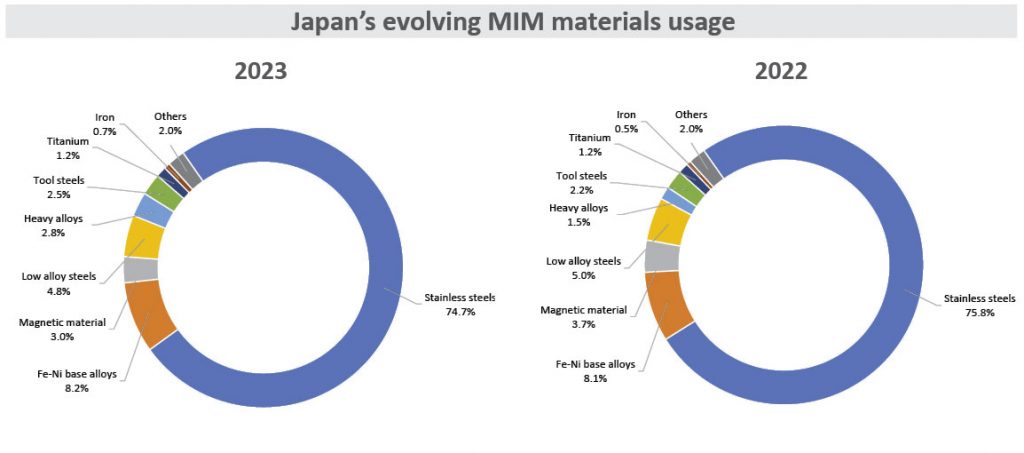
Industrial machinery parts were reported as accounting for 34.1% of the market (previous year: 36.5%); medical appliance parts accounted for 21.4% (previous year: 21.9%); and automotive applications accounted for 12.4% (previous year: 12.0%). In terms of the MIM materials mix, stainless steels accounted for 74.7% of sales (previous year: 75.8%); and together, stainless steels, Fe-Ni base alloys, low-alloy steels, and magnetic materials accounted for over 90% of sales. The JPMA stated that the sales value for stainless steels was ¥9,401 million ($61,620 million), a 14.4% decrease from the previous year (Fig. 4).
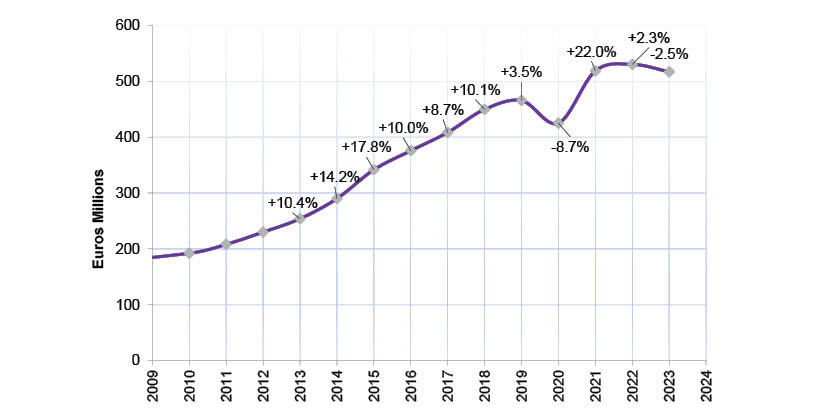
It should be noted that Europe also recorded a drop in sales for 2023, according to data presented by the European Powder Metallurgy Association (EPMA), shown in Fig. 5. Commenting on the state of MIM in Europe during his global market review presentation, EPMA President Ralf Carlström stated, “It looks like MIM has lost a bit of its momentum in Europe, after showing steady growth for many years. We think that the decline that we saw in 2023 is connected to the downturn in German industry.” Carlström noted, however, that the aerospace industry, in particular, will be an important growth market for MIM in Europe.
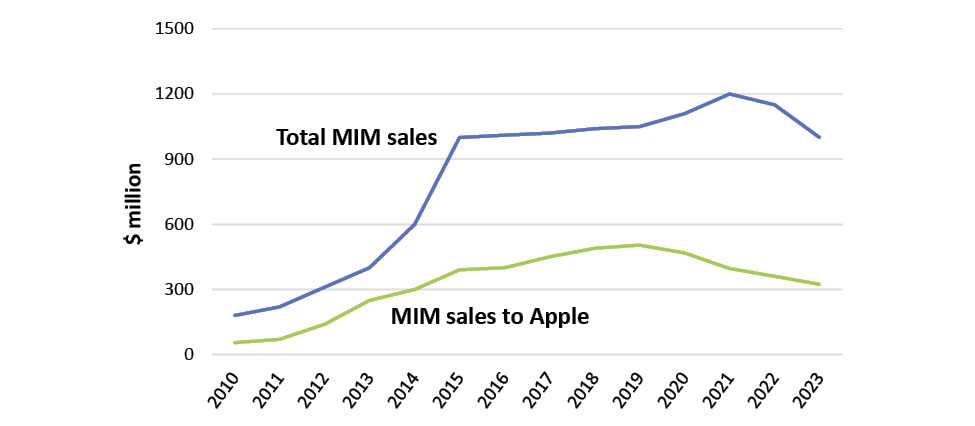
Even the world’s largest MIM-producing nation, China, appears to be seeing a dip in MIM sales as reported in the Spring 2024 issue of PIM International, driven by the loss of some key Apple applications, such as the Lightning connector (Fig. 6).
No published data is available for MIM sales in North America. However, given reduced gun sales – a market in which MIM parts are extensively used – it would be no surprise if the picture were similar.

Where does this leave the MIM industry?
Speaking with MIM producers at World PM2024, the reported figures do not appear to be a cause for panic. Many MIM producers serve a diverse range of markets, and these companies are, therefore, protected from any crisis that hits one particular sector. Whilst the challenging global economic and geopolitical situation can be cited as a reason for the decline in MIM shipments, there is also a continuing ‘ripple effect’ of post-COVID-19 supply chain disruptions.
However, there is a recognition that the MIM industry has to continue developing new markets. This is particularly the case in world regions that have traditionally been dominated by one particular end-user sector: in the case of China, smartphone parts, and in Europe, automotive applications.
In China, whilst small and medium firms press ahead with diversification, the larger companies are eyeing a new generation of smartphone and 5G applications (in the former for foldable devices where MIM is used for hinge mechanisms) (Fig. 7).
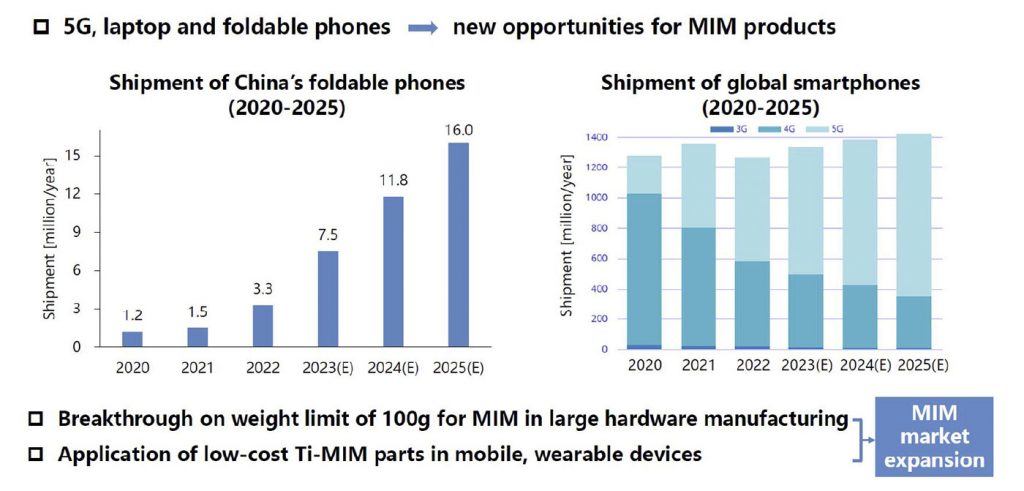
However, success in leveraging new markets for MIM is easier said than done and requires a greater level of awareness among designers and engineers. This is a challenge that the industry is still grappling with. In some cases, opportunities will arise on the back of increasing demand for specific materials, such as titanium, where MIM offers a compelling business case, particularly with the greater availability of more cost-competitive powders. There was certainly evidence of Ti-MIM’s success in the consumer electronics sector on display at the World PM2024 exhibition.
Whilst the MIM industry is also becoming ever more globally competitive, the trend to re-shore production, particularly in the US and Europe, appears to be continuing. The value of local suppliers, with reduced supply chain risk and easier communication, is a significant factor in supporting MIM operations.
With sustainability being a main theme of World PM2024, a number of conversations and presentations addressed how the industry could become more sustainable through a wide range of measures, from more efficient part design to the use of recycled materials produced with green energy and the use of green energy for sintering processes. Whilst the enthusiasm for a sustainability drive in MIM varies significantly by global region, it is becoming apparent that improved sustainability and improved efficiency can go hand-in-hand and that it will, in the not-so-distant future, be the MIM industry’s biggest customers who set strict sustainability targets, not the industry itself. Those who are prepared, therefore, will be at a significant advantage.
A time to talk: The World PM2024 MIM party
In 2012, the JPMA and JSPM organised the first PM World Congress MIM party, bringing MIM industry professionals from across the world for an evening of informal networking and entertainment. Now a firmly established tradition, the World PM2024 MIM party once again brought together MIM experts from Europe, the Americas and Asia.
The event – held on October 15 on the 70th floor of the Landmark Tower Hotel – was sponsored by Atmix, Iwaki Diecast Co Ltd, NMC, Pacific Sowa Corporation, Teibow, Castem, Osaka Yakin Kogyo Co Ltd, Taiyo Nippon Sanso, and the Society for Injection Molding Technical Research.


Delegates received a warm welcome from Kenji Doi, of Osaka Yakin Kogyo, who spoke on behalf of the entire Japanese MIM community in expressing a desire for continued international collaboration and a common effort between world regions to further grow awareness of the potential of MIM technology. Kei Takenum, from Epson Atmix, expertly performed the role of Master of Ceremonies.
Amongst several dignitaries who spoke at the event was Prof Hideki Kyogoku, Kindai University and President of Japan’s Technology Research Association for Future Additive Manufacturing (TRAFAM). Kyogoku stated that there was a growing desire to embrace metal Additive Manufacturing technology in Japan – including sinter-based AM – but he also acknowledged that the country had some catching up to do.
It was encouraging to see the MIM party tradition continue, with the networking opportunities fuelled by a sake selection from northern Japan (Denshu, Hassen, Kamekichi, and Kikunoi) sponsored by Epson Atmix, served with traditional ‘masu’ wooden drinking boxes.
Conclusion
With PM2024, the PM World Congress series once again lived up to its reputation as providing the opportunity to interact with a far more diverse group of participants than the regional industry events allow. Participants gained new perspectives and established valuable connections. The PIM International team looks forward to the next successful event in the series, WorldPM2026, scheduled to take place in Montreal, Canada, June 25-29, 2026.
Author
Nick Williams
Managing Editor
PIM International
[email protected]
www.pim-international.com