

Accelerating metal Binder Jetting in Greater China: MIM industry collaboration and a new applications centre with HP
If you were to place a bet on which country was going to take metal Binder Jetting to the highest volumes of commercial production, China would probably be high on your list. As the world’s manufacturing hub for consumer electronics, China already accounts for nearly half of global MIM sales by value. So with markets on the doorstep, and sintering capacity and metal powder supplies ready and waiting, where’s Binder Jetting in China? Here, Dr Q and Dr James report on developments, including a new Sintering Application Center at BJ–TECH Co. featuring HP’s Metal Jet technology. [First published in PIM International Vol. 18 No. 2, Summer 2024 | 10 minute read | View on Issuu | Download PDF]

Binder Jetting (BJT) is one of the seven Additive Manufacturing technologies defined in the ISO/ASTM 52900 International Standard. The technology enables the use of a wide range of metal and ceramic powders to form ‘green’ parts at a relatively high speed.
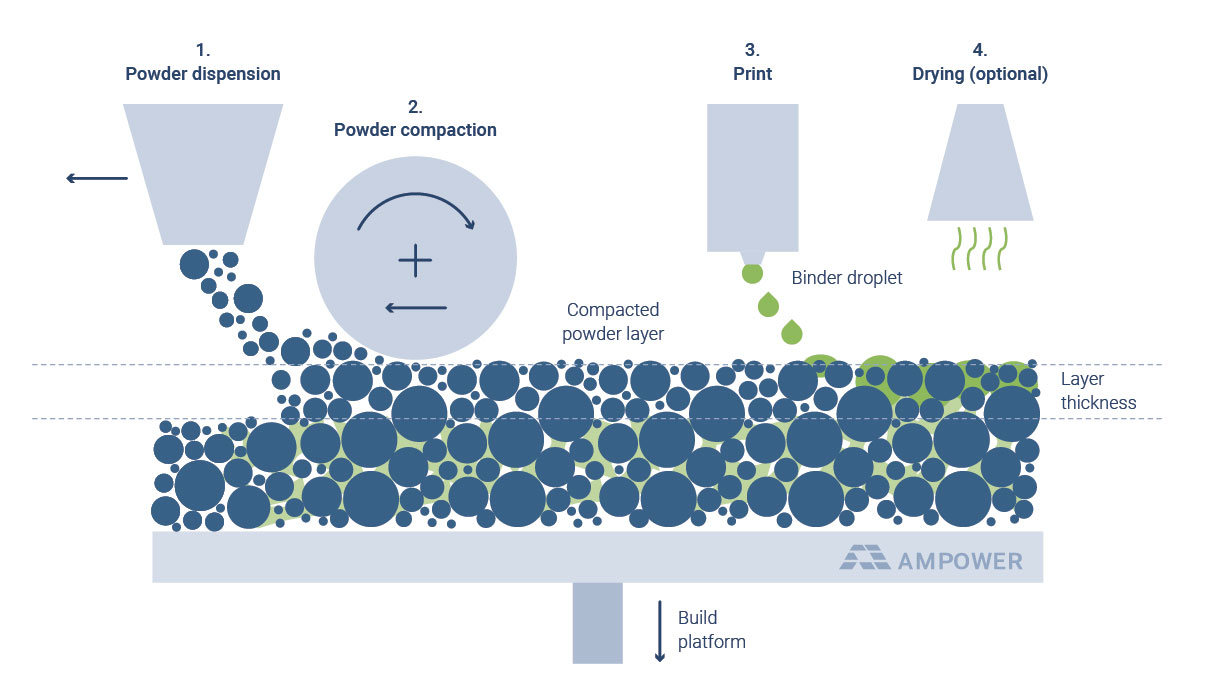
These green parts are produced by selectively spraying a liquid binder into a metal powder bed. The parts are then sintered to obtain dense functional components. During the BJT process (Fig. 1), the sprayed binder droplets interact with the powder particles, bonding together to form the unit of the cross-sectional layer. Once a layer is completed, a new layer of powder is reapplied on top of the previous layer, and the layer-by-layer process is repeated to create a finished green part.
The unbound loose powder in the powder bed surrounding the parts supports any inverted or overhanging structures during the build process and can be removed using, for example, compressed air after the build.
Once the powder has been removed, the green parts undergo thermal treatment to burn off the binder and then sinter the powder particles together to produce the part at full density and strength.
The global and Chinese BJT machinery landscape
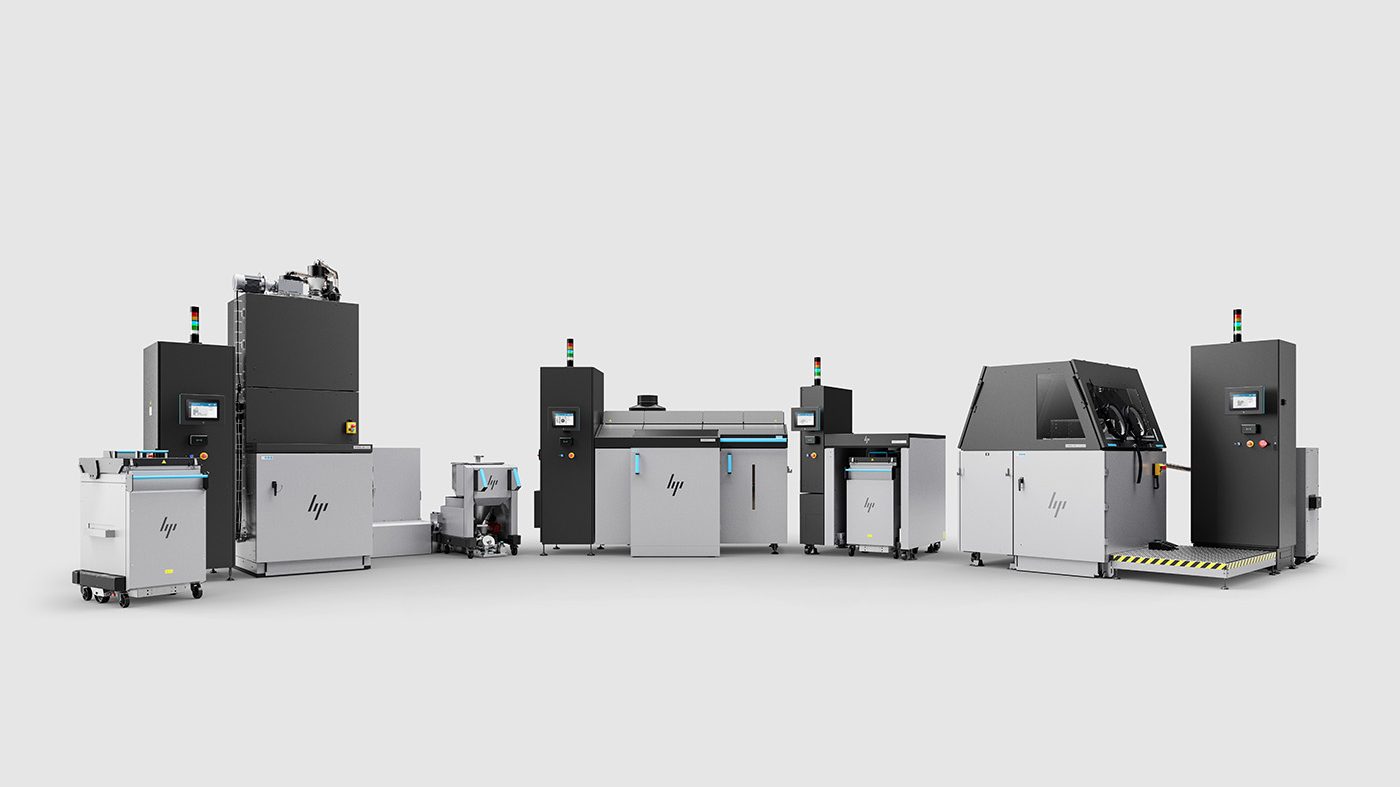
At the end of 2023, I undertook a survey of Binder Jetting machine manufacturers. As one would expect, the most well-known companies in the field are Desktop Metal (incorporating ExOne) and HP (Fig. 2).
The offerings from both these companies are quite transparent, and there is potential for third-party powder usage and cooperation with third-party sintering suppliers. From my experience with potential purchasers of such technology, the greater the level of system openness and transparency, the lower the level of hesitation from potential users and, therefore, the greater the potential demand.
Japan’s Ricoh is also developing its technology in this space, and was quite open about its plans. Chinese manufacturers of Binder Jetting machines are all relatively conservative in their reporting and further data will be gathered this year. One Chinese BJT machine producer with growing visibility is EASYMFG, based in Wuhan (Fig. 3).

The current status of Chinese BJT parts manufacturers has also been studied. Due to the confidentiality demands of end-user customers, actual data disclosure is rare, but it can be understood that there are many projects underway and that more customers will start using BJT in the second half of 2024.
Some of the most noteworthy among these are the customers from the Metal Injection Moulding industry, where producers are using their long-established MIM sintering equipment and post-processing capabilities (CNC machining, heat treatment, polishing, etc.) to accelerate the adoption of BJT. This has been a trend for some 3C applications since 2020.
The specific nature of the types of orders is difficult to ascertain, although we know they take advantage of BJT’s fast prototyping and aesthetic capabilities. Customers’ demand for samples in a short period of time – or even for small production runs to test the market’s temperature – has also enabled MIM manufacturing companies to have product breakthroughs even during the COVID-19 pandemic. Using this as a metric, it is fair to assume there will be growing demand for products even beyond 3C from this year.
Two BJT contract manufacturers as of the end of 2023 are listed in Table 1.

Binder Jetting trends in China
It is my belief that BJT machine providers will form strong alliances with the MIM industry to improve the design and mass production of small, MIM-like metal products in small, medium and large production volumes from, for example, 100 to 10,000 parts and beyond.
The following concerns exist in the minds of those moving forward in this combined industry:
Powder shape and particle size
At present, powder usage specifications of Binder Jetting are in the range of d10 >3 µm, d50 = 15-18 µm, and d90 <30 µm, with one current limitation being the need to use gas atomised powders with high sphericity. Compared with MIM, where the mainstream values are d10 >0.5 µm, d50 = 5-15 µm (determined by surface roughness and material type requirements) and d90 <22 µm, there is a significant gap.
This means the price of BJT powder is still higher than that of MIM. The metal powder industry must be looked to in order to solve this gap between BJT and MIM. As part of this work, we are currently researching the application of hybrid water/gas atomised powders in BJT.
Materials diversification
Compared to the wide variety of MIM materials processed, BJT is typically limited to stainless steels and tool steels, with 304L, 316L, 17-4PH, and 18Ni300 being the main materials. A small number of non-ferrous metals are cobalt, aluminium, copper, and titanium alloys. The powder must, of course, be a pure elemental powder or a powder that has been fully pre-alloyed. External research is needed to address certain challenges when processing some specific alloys.
Sintering process considerations
BJT is an ‘indirect’ Additive Manufacturing, meaning that parts require a subsequent sintering step to achieve their final properties. This is in contrast to ‘direct’ AM processes such as Laser Beam Powder Bed Fusion (PBF-LB). However, BJT and other sinter-based AM technologies stand out from direct AM technologies through their low-energy consumption in the forming of green parts, high build rates, and the potential to sinter large quantities of parts at a time. This energy-efficient approach has been shown to be successful in the MIM industry for many years.
However, if a green part does not have a suitable flat area that can be used when it is placed on sintering trays, the green parts must be additively manufactured with a support base during the build process to support them as they shrink during the sintering process, thus avoiding deformation (Fig. 4).
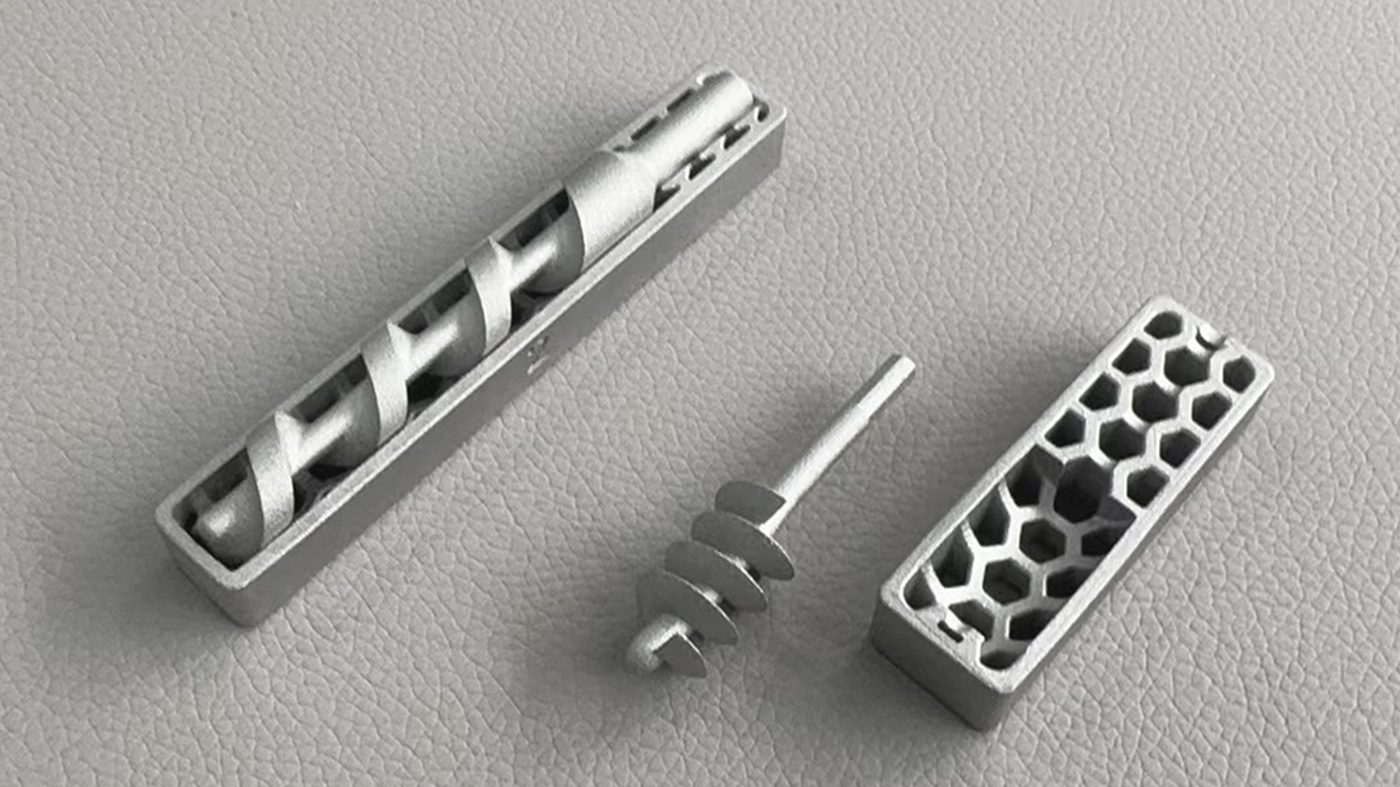
Compared to sintering supports in MIM that can be reused, these ‘live setters’ require additional material consumption. This is an area for further study. Such problems are not unique to BJT; overcoming deformation caused by gravity, friction, and material phase changes is a common issue in powder-forming technologies and has been solved in other processes.
Fully leveraging resources from the MIM industry
In addition to the powder used, sintering technology is crucial to the success or failure of BJT. Fortunately, the larger powder particles used makes BJT sintering less likely to fail. In addition to this inherent advantage, China’s MIM sintering equipment industry has made rapid progress since 2012. This means that one of BJT’s biggest challenges – sintering – should be relatively easy to overcome.
In the future, it is our intention to develop easily movable green part processing and depowdering solutions. It is only with the full automation of the BJT process that MIM operators will be able to significantly expand the technology’s use.
The post-treatment of parts will also have to become standard for Binder Jetting. In addition to sintering and machining, these include surface treatment technologies such as sealing, polishing, electroplating, and PVD coating.
This value-added treatment service for products has already found a home in the Pearl River Delta region, which has many years of experience in the manufacturing of MIM watches, jewellery, and mobile phone parts.
HP Metal Jet applications centre
In December 2023, Guangdong BJ Tech Co, Ltd teamed up with HP to establish the Sintering Application Center of HP Metal Jet. The company is located in Silicon Valley Power 2025 Park, Dongcheng District, Dongguan City, Guangdong Province.
The company is investing in the latest Binder Jetting contract manufacturing technology and is focused on serving the thriving Greater Bay Area (Guangdong, Hong Kong, and Macao), providing sample and small-scale production services of 316L and 17-4PH parts to a wide range of designers and customers. A dedicated high-pressure sintering furnace from Sinterzone Technology Co., Ltd is installed, and my consultancy, You neeD Technical Office, is commissioned to provide support for sintering and metal parts post-treatment.
More materials are expected to be launched by the end of this year, including other stainless steels, tool steels, copper, and popular titanium alloys. These additions are expected to gradually build up the promotion of BJT in China and, eventually, the world.
In the future, the certification of Chinese-made powders will also be undertaken, allowing more Chinese powder manufacturers to participate in the global Binder Jetting industry.
The future of BJT in China
As Laser Beam Powder Bed Fusion (PBF-LB) has developed over the past two decades, so BJT is bound to experience the same tests and growth. At present, there is still difficulty when challenging traditional metal processing. While industry can accept the fact that metal AM products are currently more expensive, the biggest challenge that metal AM technology faces is comparing dimensional accuracy and mechanical performance with traditionally manufactured products.
So many of the technical reference articles and reports that I have reviewed as part of my BJT technology survey only discuss the green part forming stage of the process. It appears that too many in the industry are unfamiliar with the critical high-temperature sintering step.
When it comes to powder handling in the BJT process, there also appears to be a lack of willingness to break the status quo and create technical solutions for depowdering that will work in industrial settings.
These are all stumbling blocks ahead of metal Binder Jetting entering the industrial manufacturing and mass production arenas in the next five years. We look forward to more young people joining the ranks of this new powder forming technology, thus adding to the gathered wisdom and accumulated experience to break through any limitations of the technology.
Contact
Dr Q (Y H Chiou)
You neeD Technical Office
[email protected]