

Cecimo supports call for increased FP10 research funding
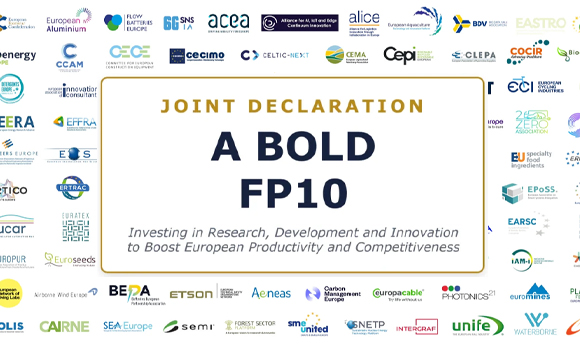
Cecimo is among 87 other European associations, including the European Powder Metallurgy Association (EPMA), that have signed a joint declaration fully endorsing the findings of the Draghi report on European Competitiveness, and urgently calling on “EU Institutions to act with commensurate ambition in designing and funding the next Framework Programme for Research and Innovation (FP10).”

The report claims that Europe’s productivity growth has stalled and that the region’s innovation gap with the United States and China is widening. It states that the continent risks a slow but irreversible decline in its economic standing. At the same time, the Competitiveness Compass and the EU’s political guidelines place research, development and innovation (RD&I) at the heart of Europe’s strategy to reverse this trend.
The Draghi report calls for an additional €800 billion per year in investment to close Europe’s competitiveness gap, with RD&I as the primary driver of sustainable productivity gains. The associations state that innovation-led productivity growth represents the only credible path to financing Europe’s green and digital transitions, its open strategic autonomy, and its social model. FP10 is reportedly the EU’s principal instrument for catalysing this transformation. The associations claim that its track record of leveraging private investment, maturing technologies, and building the cross-border collaborative ecosystems that no single Member State can replicate alone makes it uniquely placed to deliver at the scale and speed Europe requires.
The declaration states that current EU RD&I spending remains wholly insufficient relative to this challenge. Europe reportedly invests significantly less in R&D as a share of GDP than its main global competitors, and the leverage effects of the Framework Programme, demonstrated in the Horizon 2020 ex-post evaluation, mean that every euro of EU public investment generates multiples in private and national co-investment. The associations claim that cutting or stagnating FP10’s budget would undermine the public-private partnerships, technology maturation pipelines, and talent networks that they deem indispensable to restoring European productivity growth.
The associations therefore call on EU institutions to:
- Allocate a substantially increased budget to FP10, commensurate with the ambition set out in the Draghi report and the Competitiveness Compass, over the 2028–2034 Multiannual Financial Framework (MFF) period;
- Reinforce collaborative, industry-driven RD&I through a strengthened Pillar II, ensuring that public-private partnerships continue to reduce investment risk, accelerate technology maturation and translate research excellence into market-ready innovations that boost productivity;
- Ensure FP10, together with ECF, supports the full RD&I continuum, from fundamental research to deployment and scale-up, aligned with EU strategic priorities and clearly defined industrial needs, including the green and digital transitions and European security and resilience. Preserving a strong ECF and FP10, both in terms of budget and in terms of governance and synergies between the two programmes is essential to support the entire innovation cycle, strengthen Europe’s industrial base, and deliver on the Union’s competitiveness objectives.
The window of opportunity is narrow, the partners state. Decisions taken in the coming months on the next MFF will reportedly determine whether Europe has the RD&I firepower to compete globally and sustain its prosperity.