

3DCeram Sinto highlights ceramic AM partnership with Avignon
3DCeram Sinto, based in Bonnac-La-Côte, France, has released a new video highlighting its partnership with Avignon Ceramic, based in Bruère-Allichamps, and the role of ceramic Additive Manufacturing in producing complex ceramic cores for investment casting applications.

Founded in 1870, Avignon Ceramic employs around 180 people and specialises in Ceramic Injection Moulding (CIM) for the production of ceramic cores used in investment casting. Its components are supplied to customers in the aerospace and gas turbine sectors, including Howmet, Rolls-Royce and Safran.
According to the companies, increasing demand for more complex core geometries, including double- and triple-wall designs that cannot be produced by conventional injection moulding, led Avignon Ceramic to invest in ceramic Additive Manufacturing in 2017. This led to the collaboration with 3DCeram.
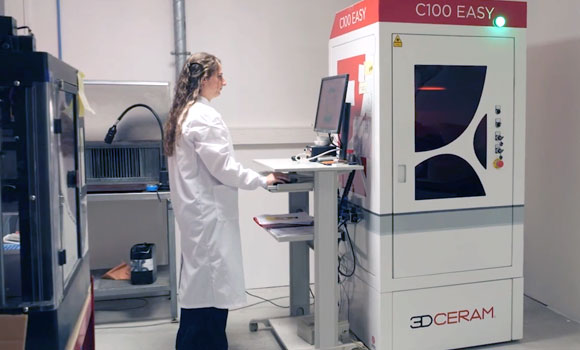
In the video, Julie Josso, Chemical Engineer – Materials at Avignon Ceramic, discusses the company’s use of 3DCeram’s C100 Easy ceramic Additive Manufacturing machine.
Josso explains that the machine’s adjustable processing parameters enable the production of a wide variety of ceramic components while meeting the requirements of industrial applications. Using a top-down stereolithography (SLA) process, the company states that it is able to produce parts with high dimensional fidelity to CAD data while reducing defects such as delamination and warping. She goes on to describe the machine as straightforward to operate and requiring relatively little maintenance, making it suitable for regular industrial use.
The companies state that the partnership combines Avignon Ceramic’s expertise in ceramic materials and core production with 3DCeram’s knowledge of photopolymer binder systems for ceramic Additive Manufacturing. Together, they have developed an SLA ceramic paste suitable for AM, intended for ceramic cores used in directionally solidified (DS) and single-crystal (SX) investment castings.
According to the companies, the process has significantly reduced lead times: while the manufacture of conventional tooling can take several weeks or months, ceramic Additive Manufacturing enables finished ceramic cores—including manufacturing, firing and finishing—to be produced in up to two weeks. Design modifications can also be implemented within hours by updating the digital model rather than manufacturing new tooling.
The companies add that this capability was demonstrated during a 2025 aerospace evaluation programme for military components, which they state subsequently progressed to short-run production.
3DCeram and Avignon Ceramic plan to continue developing the process, aiming to control the complete production chain, from feedstock development through to finished ceramic parts. This work is intended to improve mechanical performance, dimensional accuracy and surface finish while supporting the wider industrial adoption of ceramic Additive Manufacturing.