

Ricoh develops diffusion bonding technology for joining aluminium Binder Jetting components

Ricoh Company, Ltd, headquartered in Kanagawa, Japan, has developed a process to join aluminium parts fabricated by Binder Jetting (BJT) to wrought aluminium alloy. This new technique not only eases the restriction on the size of parts fabricated by Binder Jetting, but it also has the potential to significantly reduce costs.
Metal Binder Jetting is a highly productive and low-cost Additive Manufacturing technology that can be used for prototyping and series manufacturing. However, because BJT requires sintering, it can be difficult to ensure accuracy when manufacturing very large parts, explains Ricoh.
TRUSTED BY INDUSTRY’S BIGGEST NAMES
Discover how we help leading brands shape the industry conversation
| Contact us |
Ricoh’s newly developed diffusion bonding technology for sintered materials fabricated by the BJT method solves the above issues. The company is using its proprietary liquid-phase sintering technology, which is useful in the fabrication of high-efficiency heat exchangers and other applications.
A heat exchanger consists mainly of fins that determine cooling performance and a case that determines the component’s dimensional accuracy. Ricoh’s idea is to use BJT to make fins of complex shapes and join them to an aluminium case prepared using an existing method. BJT’s ability to fabricate complex shapes allows for highly efficient cooling performance, while the machining accuracy of existing methods ensures the dimensional accuracy of the component.

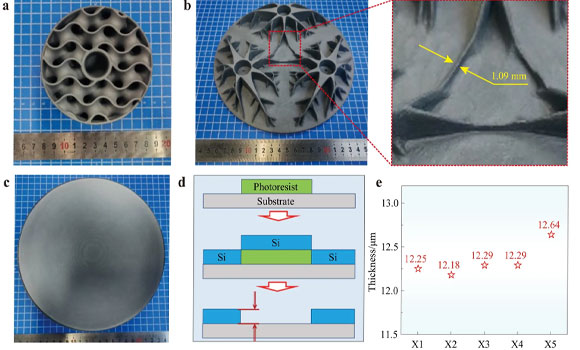
Fig. 2 shows a sample of 6061 aluminium bonded to a gyroid-type fin. The fin is fabricated with the aluminium BJT and joined to the base using the newly developed diffusion bonding technique. Its appearance shows that the gyroid shape created by the BLT machine is joined to the 6061 block without distortion. The cross-sectional image also shows that there are few voids at the interface between the BJT sintered body and the 6061 block. By utilising this bonding technique, a component with three fins (gyroid) bonded to the case can be made, producing a heat exchanger as shown in Fig. 1.
Fig. 3 shows an example of a large component fabricated by combining this diffusion bonding technique with conventional brazing. Ten gyroids made by aluminium BJT are diffusion bonded inside a 1050 aluminium case. The case and lid are joined by conventional brazing. The external dimensions of this component are 400 mm x 160 mm x 10 mm. Such a large cooling component can be difficult to make in one piece using BJT, explains Ricoh, but is possible using the diffusion bonding technology.
In addition to 6061 and 1050 aluminium alloys, Ricoh’s diffusion bonding technology has also been confirmed to be capable of joining 6063 aluminium and BJT sintered bodies.

The diffusion bonding method is based on technology that controls the amount of aluminium liquid phase accumulated in the development of the sintering process for Ricoh’s aluminium BJT machine. Unlike brazing, this technique does not require flux or brazing material. Brazing is a typical technique for joining aluminium, but there are limitations to the aluminium alloy compositions that can be used for brazing. Aluminium alloys for Additive Manufacturing, including Powder Bed Fusion (PBF), have been developed to make the method work, but they are not necessarily suitable for brazing. Ricoh’s technology is reported to be novel, in that both the Binder Jetting and the joining process are effective.
Takafumi Sasaki, head of the metal BJT project at Ricoh, stated, “This unique bonding technology will achieve both improved cooling efficiency and reduced component costs, and also allow for larger component sizes. This technology will bring our customers closer to utilising aluminium BJT in the manufacturing field. We plan to further validate its manufacturing feasibility in the real market through collaborations with our customers.”