

Researchers at Politecnico di Torino publish on metal powder cross-contamination analysis
NewsResearch
May 22, 2024
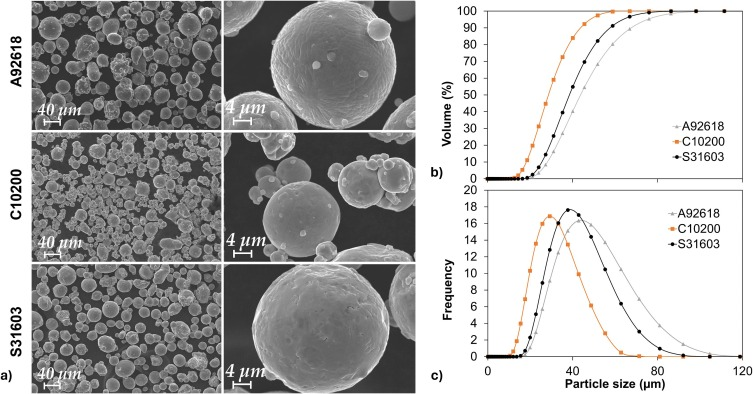
SEM image (a) of the surface morphology of the three different commercial powders atomised powders; b-c) size distribution of the three types of powders (As published in Ultraviolet–Visible-Near InfraRed spectroscopy for assessing metal powder cross-contamination: A multivariate approach for a quantitative analysis, Courtesy Materials & Design)

Researchers at Politecnico di Torino, Turin, Italy, have published a paper in Materials & Design entitled ‘Ultraviolet–Visible-Near InfraRed spectroscopy for assessing metal powder cross-contamination: A multivariate approach for a quantitative analysis’ focusing on assessing three binary systems obtained from the cross-contamination of three components, A92618, C10200 and S31603, in a low contamination range, from 0.5 vol% to vol. 6%, and in a high contamination range of 25 vol% and vol. 50%.

The last few years have seen increasing use of spherical metal powders to produce bulk parts through metal-forming technologies like Additive Manufacturing and Metal Injection Molding, the authors state. This, paired with the wide availability of metal powders, leads to a critical issue: contamination across different systems in different process steps. As a result, it is necessary to find a new, faster, and more reliable analysis sensitive to traces of contamination.

TRUSTED BY INDUSTRY’S BIGGEST NAMES
Discover how we help leading brands shape the industry conversation
Contact us

This work by Politecnico di Torino researchers evaluates the applicability of Ultraviolet-Visible-Near-InfraRed (UV-Vis-NIR) spectroscopy, a technique providing information on powders’ reflectance, for studying contaminated powders.

After the UV-Vis-NIR analysis, multivariate analysis has been used to obtain quantitative results. The results show that, as the contamination level increases in the binary system, the shape of spectra changes and becomes progressively more similar to the contaminant one. The chemometric analysis allows for the detection of the contaminant type and its concentration percentage in the contaminated powder.

Read the full paper here.

www.polito.it

GET THIS ISSUE:  PDF  |  VIEW ONLINE  |  BUYER’S GUIDE
NewsResearch
May 22, 2024

In the latest issue of PIM International…

Download PDF

Extensive MIM, CIM industry and sinter-based AM industry news, plus the following exclusive deep-dive articles and reports:

  • Element 22: Mastering titanium component production with Metal Injection Moulding and Additive Manufacturing
  • Advancing industrialisation: Binder Jetting at the forefront of a maturing sinter-based AM landscape
  • Tailored feedstocks for MIM, CIM and sinter-based AM: How Blesol Tech is responding to market requirements
  • Cleaner semiconductor etching: Bosch Advanced Ceramics’ two-part AM injector produced with Lithoz technology

Buyer’s Guide: feedstock, powder, production technology and MIM, CIM and AM parts

Discover suppliers of these and more in our advertisers’ index and buyer’s guide, available in the back of PIM International.

  • Metal powders
  • MIM, CIM & AM parts producers
  • Binders & feedstocks
  • Feedstock mixers
  • Furnaces & furnace supplies
  • Atmospheres & gas generation
  • HIP systems & services
  • Injection moulding machines
  • AM technology
  • Debinding systems
View online

Register for our fortnightly newsletter

Don't miss any new issue of PIM International, and stay up to date with the latest industry news. Sign up to our fortnightly newsletter.

Sign up

Join our community

Discover our magazine archive…

The free-to-access PIM International magazine archive offers unparalleled insight into the world of MIM, CIM and sinter-based AM from a commercial and technological perspective through:

  • Reports on visits to leading part manufacturers and industry suppliers
  • Articles on technology and application trends
  • Information on materials developments
  • Reviews of key technical presentations from the international conference circuit
  • International industry news

All past issues are available to download as free PDFs or view in your browser.


Browse the archive


Share via
Copy link
Powered by Social Snap