

Researchers use adaptive slicing to reduce Binder Jetting build time
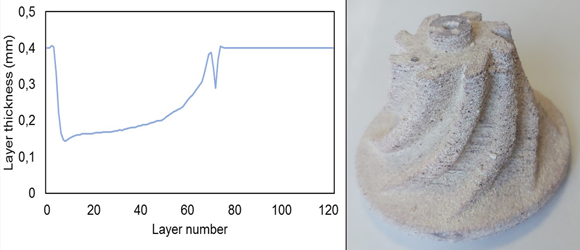
Using adaptive slicing and a custom variable binder amount algorithm, researchers achieved a 40% reduction of Binder Jetting Additive Manufacturing times (Courtesy Hasan Baş, Research Assistant, Ondokuz Mayıs University)
Using adaptive slicing and a custom variable binder amount algorithm, researchers achieved a 40% reduction of Binder Jetting times (Courtesy Hasan Baş, Research Assistant, Ondokuz Mayıs University)

Researchers from Ondokuz Mayıs University, Samsun, Türkiye, have published work in Rapid Prototyping Journal which focused on the use of adaptive slicing in Binder Jetting Additive Manufacturing. Slicing is an essential step for all Additive Manufacturing technologies, though this slicing is usually performed uniformly.

Unlike uniform slicing, layer thicknesses are variable in adaptive slicing. Adaptive slicing has been used for a long time in Fused Filament Fabrication, a form of Material Extrusion technology, but the authors claim it has not been fully explored or tested for the Binder Jetting process. The reasons for this, they suggest, is that slicing software used for Binder Jetting does not allow adaptive slicing, or that the commercial BJT machines used are unsuitable for applying adaptive slicing.
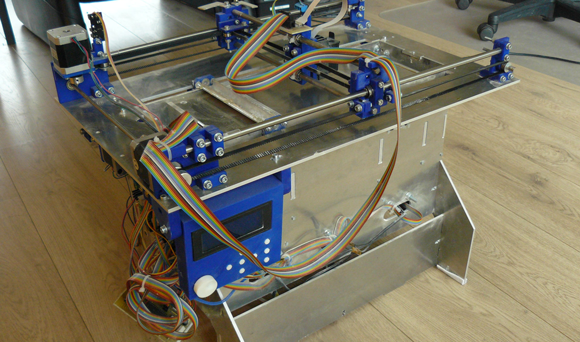
The Plan B is an open source Binder Jetting machine, printing in powder with a custom binder. It is constructed from common 3D printer parts and of the shelf inkjet technology. It offers a resolution of 96 DPI (roughly 0.26 mm per dot) and costs around €1000 to make (Courtesy Ytec3D)

In an effort to remedy this lack of study, the Ondokuz Mayıs researchers implemented adaptive slicing using an open-source Additive Manufacturing machine (a Plan B from Ytec3D), open-source slicing software (Slic3r), and a self-developed variable binder amount algorithm (VBAA).

VBAA is an algorithm developed for the efficient use of adaptive slicing, included in the software of the open-source AM machine. A VBAA is a necessity, as, if it’s not used, the same amount of binder is sent to layers regardless of any difference in thickness. This presents an issue as if too much binder is sent to a thinner layer, the dimension expands and the surface roughness increases – if too little binder is sent, parts may break.

TRUSTED BY INDUSTRY’S BIGGEST NAMES
Discover how we help leading brands shape the industry conversation
Contact us

Samples were sintered at 1250°C for 2 h with 10°C/min heating and cooling ramp. Scanning electron microscope (SEM) analysis, surface roughness tests, and density calculations were done. According to the results obtained from the analyses, similar surface quality is achieved by using 38% fewer layers than uniform slicing.

Using adaptive slicing and their VBAA algorithm, the researchers reportedly achieved a reduction of Binder Jetting times of 40%. In addition, with the reduction of manufacturing times, the surface roughness did not increase, and there was no change in the part density. These results should be replicable in all commercial Binder Jetting machines as the published work is based on open-source software.

The researchers have applied for a patent for their work, and their patent application won a bronze medal at the ISIF 2023 8th Istanbul International Invention Fair.

The study, ‘Using adaptive slicing method and variable binder amount algorithm in binder jetting,’ is available here.

www.omu.edu.tr

GET THIS ISSUE:  PDF  |  VIEW ONLINE  |  BUYER’S GUIDE

In the latest issue of PIM International…

Download PDF

Extensive MIM, CIM industry and sinter-based AM industry news, plus the following exclusive deep-dive articles and reports:

  • Element 22: Mastering titanium component production with Metal Injection Moulding and Additive Manufacturing
  • Advancing industrialisation: Binder Jetting at the forefront of a maturing sinter-based AM landscape
  • Tailored feedstocks for MIM, CIM and sinter-based AM: How Blesol Tech is responding to market requirements
  • Cleaner semiconductor etching: Bosch Advanced Ceramics’ two-part AM injector produced with Lithoz technology

Buyer’s Guide: feedstock, powder, production technology and MIM, CIM and AM parts

Discover suppliers of these and more in our advertisers’ index and buyer’s guide, available in the back of PIM International.

  • Metal powders
  • MIM, CIM & AM parts producers
  • Binders & feedstocks
  • Feedstock mixers
  • Furnaces & furnace supplies
  • Atmospheres & gas generation
  • HIP systems & services
  • Injection moulding machines
  • AM technology
  • Debinding systems
View online

Register for our fortnightly newsletter

Don't miss any new issue of PIM International, and stay up to date with the latest industry news. Sign up to our fortnightly newsletter.

Sign up

Join our community

Discover our magazine archive…

The free-to-access PIM International magazine archive offers unparalleled insight into the world of MIM, CIM and sinter-based AM from a commercial and technological perspective through:

  • Reports on visits to leading part manufacturers and industry suppliers
  • Articles on technology and application trends
  • Information on materials developments
  • Reviews of key technical presentations from the international conference circuit
  • International industry news

All past issues are available to download as free PDFs or view in your browser.


Browse the archive


Share via
Copy link
Powered by Social Snap