
Shopping Basket
Download content from PIM International

Quantitative study of powder binder separation of feedstocks
More...
Metal Injection Mouldings Ltd - Flexibility helps MIM producer meet the demands of a broad client base
More...
Schunk Sintermetalltechnik: Leading German manufacturer works to develop the market for Metal Injection Moulding in the automotive sector
More...
Powder Metallurgy: A global market review
More...
PM self-lubricating bearings continue to make advances
More...
Applications for metal injection moulded products, Part 1
Many objects we encounter in everyday life such as household appliances, photo cameras and power tools contain metal injection moulded parts.
The electronics industry is increasingly using metal injection moulded parts too. Connectors of complex geometry offer themselves as metal injection moulded products and the miniaturization of electronic devices calls for ever smaller parts with better performance at lower cost. This is where metal injection moulding can put forward its strengths.
So many applications for metal injection moulding have been published to date that it is impossible to give a compre-hensive overview, but a few examples may show the wide variety of applications and the strengths and potentials of this technology.
Medical and orthodontic applications
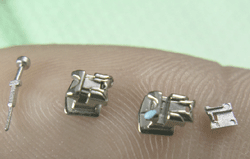
One of the first applications for metal injection moulding were orthodontic brackets and today this is a standard product (Fig. 8, see Materials section). They are usually made from 316L stainless steel.
A further application in medicine technology is the port system known as porthales. The housing (Fig. 9, see Materials section) is made from MIM-Ti6Al4V (a titanium-aluminium-vanadium alloy). The product is long-term implantable. It provides sterile access for multiple drug applications, e.g. in chemo therapy or pain therapy. Metal injection moulding allows a combined production in one piece of case and catheter connector without additional joining processes. The connector features a bore diameter of only 0.5 mm. The size of the housing is width 30 mm, length 28 mm, height 12 mm, weight 10 g.
Base plate for an infusion pump (Fig. 10) is made from MIM-Ti6Al4V. The base plate, the most expensive part of the pump, combines several functional elements. The extreme aspect ratio of 78 mm diameter and a wall thickness of only 1 mm is almost impossible to realise with conventional cold runner toolings, but with a hot runner this mould can be completely filled with high reliability.
The moulded part weighing almost 50 g exhibits a diameter of 78 mm and a height of 3 mm. The wall thickness varies be-tween 1.0 and 1.5 mm. Two small bores are moulded in, a conical one with 0.8 mm at the top and 0.4 mm at the bottom, and a cylindrical one with 0.5 mm diameter.
Typical mechanical test values of MIM-Ti6Al4V are 800 MPa tensile strength, 700 MPa yield strength and 15% elongation. See also Titanium and titanium alloys for medical applications: opportunities and challenges and Powder injection moulding in the medical and dental sectors, both available for instant download in our PDF Store.
Ordnance applications
The first metal injection moulded parts were made for firearms, particularly in the United States, and this is still an application of some importance. In Europe there is also a major market for military metal injected moulded parts. Two examples are shown here. The worm gear (Fig. 11) with a length of 13.7 mm and a width of 4.7 mm, weighing just 0.873 g, is made from 316L stainless steel. The worm gear modulus of 0.3 and close dimensional tolerances of better than 0.02 mm are attained without subsequent treatment.
Fig. 12 shows a metal injection moulded turbine wheel made from 316L stainless steel with a diameter of 32.6 mm and a maximum thickness of 3.2 mm weighing 11.192 g. This part is manufactured without any subsequent machining or heat treatment.
Watch cases and wristwatch bracelets
Other sectors that are consuming much larger quantities of metal injection moulded products: The watch making industry produces watch cases and wristwatch bracelets made from stainless steel and hardmetal (cemented carbide) powders (Fig. 13 and 14).