

When is a part suitable for metal or ceramic injection moulding?
What is the production volume?
Because of the mould cost, MIM is not usually applied to lower production quantities, yet proves very effective for large quantities. Generally, production quantities of 200,000 or more per year are attractive.
There is little willingness to take on production runs in the range from 5,000 to 20,000 per year. Below 5,000 per year is possible, but most vendors do not like to devote engineering talent to such projects.
Thus, MIM is most attractive for component such as the mobile cell phone hinges shown in Fig. 1 (see previous page)
Is the geometry complex in three dimensions?
MIM is most effective when the component has holes, slots, ribs, protrusions, and multiple features such as evident in Fig. 2 (see previous page).
On the other hand, simple two-dimensional shapes, such as flat components with uniform section thicknesses, are better produced using stamping, rolling, or die compaction.
Is it feasible to use MIM for production?
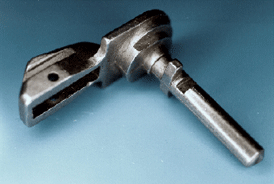
Technical feasibility is best measured with respect to the typical part profile and a good example is seen in Fig. 3.
Most MIM parts are small, complex, thin walled, and like Goldilocks ‘just right’ with neither too few or too many features. Here are some of the typical attributes [3]:
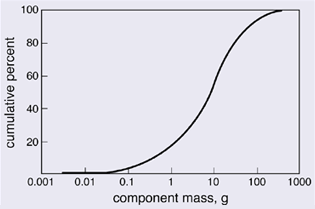
- typical mass is about 10g, but the range is from 0.02 to 500g
- the distribution in production is shown in Fig. 4
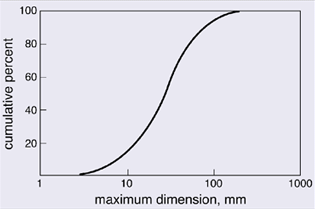
- typical maximum dimension is 25 to 35 mm, ranging up to 260 mm
- the distribution of maximum dimension is plotted in Fig. 5
- typical wall thickness often is 2 to 3mm, ranging down to 0.1 mm
- typical number of specified dimensions is near 70.
How different is MIM from plastic moulding?
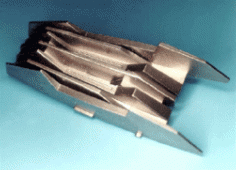
The MIM process shares many attributes with plastics. Both favour hollow and thin-walled shape, with tapers and generally slender geometries, as illustrated in Fig. 6.
Generally, if a part is possible in plastics, then it is possible via MIM, but it might not be economical.
What materials are possible?
Just about all common engineering materials have been demonstrated in the MIM process.
However, it is best to stick with stainless steels if possible. Over half of all MIM components are fabricated from stainless steels, meaning this has the largest vendor base, the largest body of process knowledge, and a low material cost due to the high production volume.
Generally, MIM is most attractive for higher melting temperature materials. It is best to avoid very strong oxide formers, reactive metals, volatile, and toxic metals.
Accordingly, beryllium, lead, manganese, and magnesium are avoided. Of the lower melting metals, aluminium has been demonstrated, yet has not reached large production levels.
What about costs?
Production viability goes beyond just part cost and includes mould cost and time to produce the mould, as well as determination if the MIM operation has the skill, time, or manpower to take on the project.
It is not easy to generalise, but tooling costs and delivery times are significant. Often, smooth surfaces and tight tolerances add much to the production cost.
Early discussions with a vendor can help determine if the MIM part is over-specified to the point where costs escalate.
Continue to next page: Optimising your design for MIM production