

Powders for Metal Injection Molding

Metal Injection Molding offers diversity: From stainless steels and low alloy steels to titanium and superalloys

In Metal Injection Molding, particle size distribution is the most important powder characteristic as this determines the sinterability and surface quality of the final product. As a general rule, the finer the powder the better.

Carbonyl iron and nickel powders

Fortunately for Metal Injection Molding technology, very fine carbonyl iron and nickel powders were already in industrial production when the process was developed.

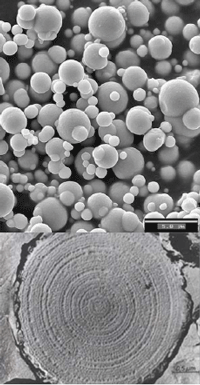
These powders have spherical particles, which is beneficial for good flowability, with particle sizes of less than 10 µm, an order of magnitude finer than the common atomised and reduced iron powders used in uniaxial powder compaction.

Carbonyl iron powder has excellent sintering properties. The small particle size provides a high sintered density, excellent strength and surface texture quality in the final part. The uniform spherical particle shape gives high dimensional accuracy.

Many ferrous MIM alloys are based on carbonyl iron and nickel. Powders are mixed with elemental or master alloy powders to achieve the desired alloy composition.
TRUSTED BY INDUSTRY’S BIGGEST NAMES
Discover how we help leading brands shape the industry conversation
Contact us

Water and gas atomised powders

Prealloyed powders are predominantly (but not exclusively) used for high alloy steels, nickel and cobalt base alloys. Alloy powders are usually gas atomised and have a spherical particle shape.

In some cases, water atomised powders with irregular particle shapes are also added.

With the growing demand for fine metal powders, manufacturers have improved their atomising techniques. Today, specialists offer many kinds of high alloy steel powders with less than 10 µm average particle size.

There are a number of well established companies supplying atomised powders for Metal Injection Molding, including producers in Europe, North America and Asia.

> Next page: Binders and Binder Removal Techniques
GET THIS ISSUE:  PDF  |  VIEW ONLINE  |  BUYER’S GUIDE

In the latest issue of PIM International…

Download PDF

Extensive MIM, CIM industry and sinter-based AM industry news, plus the following exclusive deep-dive articles and reports:

  • Element 22: Mastering titanium component production with Metal Injection Moulding and Additive Manufacturing
  • Advancing industrialisation: Binder Jetting at the forefront of a maturing sinter-based AM landscape
  • Tailored feedstocks for MIM, CIM and sinter-based AM: How Blesol Tech is responding to market requirements
  • Cleaner semiconductor etching: Bosch Advanced Ceramics’ two-part AM injector produced with Lithoz technology

Buyer’s Guide: feedstock, powder, production technology and MIM, CIM and AM parts

Discover suppliers of these and more in our advertisers’ index and buyer’s guide, available in the back of PIM International.

  • Metal powders
  • MIM, CIM & AM parts producers
  • Binders & feedstocks
  • Feedstock mixers
  • Furnaces & furnace supplies
  • Atmospheres & gas generation
  • HIP systems & services
  • Injection moulding machines
  • AM technology
  • Debinding systems
View online

Register for our fortnightly newsletter

Don't miss any new issue of PIM International, and stay up to date with the latest industry news. Sign up to our fortnightly newsletter.

Sign up

Join our community

Discover our magazine archive…

The free-to-access PIM International magazine archive offers unparalleled insight into the world of MIM, CIM and sinter-based AM from a commercial and technological perspective through:

  • Reports on visits to leading part manufacturers and industry suppliers
  • Articles on technology and application trends
  • Information on materials developments
  • Reviews of key technical presentations from the international conference circuit
  • International industry news

All past issues are available to download as free PDFs or view in your browser.


Browse the archive