

Metal Injection Molding in the aerospace industry
Technical innovations and advanced materials add to Metal Injection Molding’s appeal
Following the early successes for Metal Injection Molding in the late 1970s (see below), the technology has found a number of applications in the aerospace sector, including high performance engine components, seatbelt parts, latches and fittings, spray nozzles and vane adjustment levers, to name just a few.
Whilst the majority of current MIM aerospace applications will inevitably remain confidential, Pratt & Whitney announced in 2015 that its PurePower® PW1500G engines include Metal Injection Moulded components, as well as being the first to feature entry-into-service jet engine parts produced using Additive Manufacturing.
There has in recent years been a renewed interest from the aerospace sector in using Metal Injection Molding to manufacture superalloy components for use in critical aero engine applications.
Primary MIM materials for aerospace applications include stainless steels (316L, 410, 420, 17-4 PH, 13-8 PH), superalloys (Hastelloy X, Inconels 625, 713C and 718, Nimonic 90, and Udimet 700) and variants.
Titanium alloys TiAl and Ti-6Al-4V are also used and MIM’s ability to produce complex, high volume, high performance titanium components offers attractive possibilities to reduce aircraft weight.
Aerospace seatbelt component
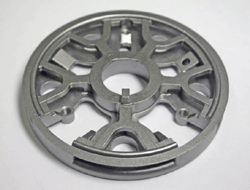
A high-strength Metal Injection Moulded seatbelt component for the aerospace sector is shown. This 90 g complex shaped part is produced from an Fe7Ni0.6C steel alloy which, after heat treatment, provides a tensile strength greater than 1200 MPa.
Typically, a part of this size (80 mm diameter) and weight would be outside the conventional size range for MIM parts. Thanks to the part’s complexity, however, Metal Injection Moulding was able to provide the most cost-effective solution.
From the history books: airliner flap screw
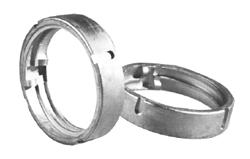
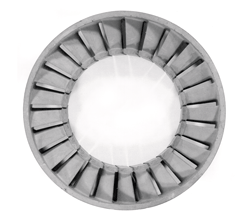
MIM’s earliest successes were in the aerospace sector. Dating from 1979, this 50.8 mm diameter ring shaped part was used in the flap mechanisms of Boeing 707 and 727 airliners, as well as the German VFW 614 transport aircraft.
In addition to corrosion resistance, the part was reported to have outstanding properties as a result of its high density, which was over 96% of theoretical.
The part was made of pure nickel with a complex configuration featuring a unique internal discontinuous thread.
Suggested reading
Metal Injection Moulding: An alternative manufacturing process for aerospace applications?
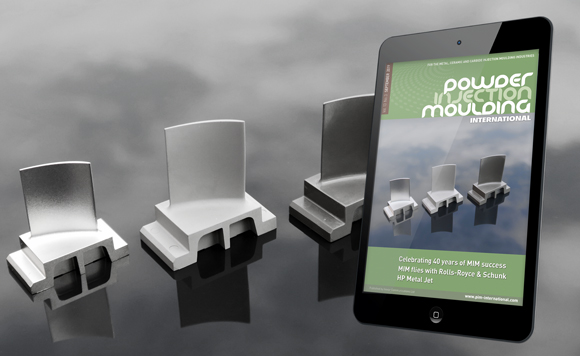
As published in Vol. 13 No. 3, September 2019 (download PDF here)
The aerospace sector has long been recognised as an important potential market for the Metal Injection Moulding industry. However, extended application development cycles, combined with a lack of fundamental process understanding and rigorous validation requirements have, until now, held back the technology.
In the following article, Rolls-Royce’s Enrico Daenicke and Schunk Sintermetalltechnik GmbH’s Ingolf Langer report on the development of a new generation of high-performance MIM components that are now flying in Rolls-Royce aero engines: IN713LC superalloy stator vanes.
Next page: Applications: Consumer Products
Download PIM International magazine