

Metal Injection Molding in the automotive industry
Automotive Metal Injection Molding applications
The automotive sector has become a major consumer of Metal Injection Molded parts. High strength, high complexity parts are used in engines, gearboxes, turbochargers, locking mechanisms, steering systems and electronic systems, to name just a few.
Rocker arms for BMW engines
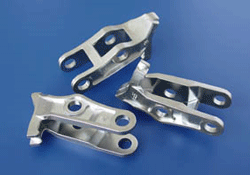
A good example of a MIM rocker arm is the roller following type arm shown.
This rocker arm was used for engines with a variable valve stroke and was made from low alloy steel. It featured a hollow configuration, saving weight, which is difficult to achieve by other processes.
The variable valve lift enhanced engine performance and reduced fuel consumption. Around 4.5 million parts were produced annually using a hardenable 50NiCrMo2.2 steel powder alloy.
Shift lever transmission component
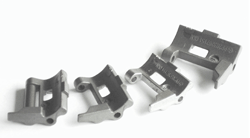
This extremely high volume Metal Injection Molded component was part of a passenger car’s manual transmission.
The component is shown in the various manufacturing stages: moulded, sintered, hardened, and assembled with a shaft.
The material is Fe-2% Ni. The part is case hardened after sintering.
Vanes for variable nozzle turbochargers
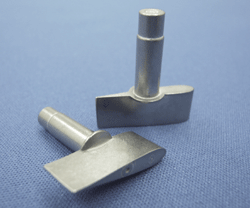
Metal Injection Molded variable nozzle turbocharger vanes are produced in very high volumes for automotive turbochargers. The parts meet strict dimensional tolerance requirements, as close as ±0.015 mm on the wing profile, which is achieved with machining.
The part shown is produced using a special tool that has a unique sliding function when opening, reducing deformation during ejection. Metal Injection Moulding production offered a 20% cost saving.
The production of Metal Injection Moulded superalloy components is now far advanced, with an ever increasing market share. Materials such as Inconel 713 are readily available as MIM feedstocks.
Metal Injection Molding, thanks to the finely dispersed powders used, delivers parts with a very homogeneous microstructure, which improves significantly on the microstructures of investment cast products.
Suggested reading
Metal Injection Moulding: Past successes and future opportunities in the automotive industry
As published in Vol. 9 No. 5, December 2015 (download PDF here)
Metal Injection Moulding has made tremendous advances over the last decade in penetrating a host of important global markets, from the aerospace and 3C industries to the automotive, medical and firearms sectors. Despite suffering from a general lack of awareness amongst automotive designers and engineers, the number of MIM automotive applications continues to rise at an impressive rate. In this report, Nick Williams, Managing Editor of PIM International, reviews the development of MIM automotive applications and the future outlook for this important end-user sector.
Next page: Applications: IT, Electronics and Telecomms
Download PIM International magazine