

Sintering in the Metal Injection Moulding process
Sintering
Sintering is essentially the same process as that used for traditional die pressed Powder Metallurgy parts and can be done in continuous or batch type furnaces, either as separate units or integrated into a complete production line.
It is carried out in protective atmospheres or in vacuum at a temperature well below the melting point of the metal. The type of sintering process and the sintering conditions are dependent on the composition and quantities of the materials to be sintered.
Unlike die pressed Powder Metallurgy compacts, Metal Injection Molded parts must undergo significant shrinkage during sintering, which may require higher sintering temperatures and/or longer sintering cycles.
A ‘green’ MIM part (before debinding and sintering) contains approximately 40 to 50% by volume or 6 to 8 mass percent of organic binder. At least two thirds of the binder is removed in the debinding step (typically either catalytic, thermal or solvent debinding) prior to sintering so that the ‘brown’ MIM compacts that enter the sintering furnace have an open pore network.
At this stage, the compacts still contain the so-called ‘backbone’ binder, a polymer that holds the powder particles together and guarantees the stability and shape retention of the parts.
Batch or continuous sintering in MIM
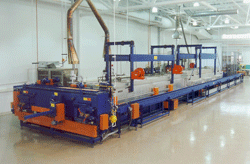
Batch vacuum furnaces are widely used in the industry, however for high volumes applications continuous debinding and sintering furnaces enable the economical mass production of ferrous MIM parts. A complete production line is composed of a bank of injection moulding machines fitted with robotic handling equipment. These parts are then feed to a continuous debinding and sintering furnace.
Placement of parts in a furnace
Parts are placed on ceramic trays or in heat resistant boxes while they are in the sintering furnace. Molybdenum is ideally suited for the high sintering temperatures in MIM. It has a high melting point, low vapour pressure, low thermal expansion, low heat capacity and heat conductivity and high strength at temperature. Its metallic properties allow bending and welding.
When used as setters for MIM parts, the parts must be separated from the molybdenum by ceramic supports, which can either be in the form of shaped or flat ceramic support plates or by coating molybdenum sheets with a ceramic layer.
Care must be taken to prevent the carburisation of molybdenum elements, which can lead to embrittlement and deformation. An excessive oxygen pressure can lead to the formation of molybdenum oxide, which evaporates in a vacuum and may form a condensate inside the furnace.
When it is reduced to metallic molybdenum at higher temperatures, an electrically conductive coating is generated, which can lead to short-cuts or arcing between heating elements and subsequently severe damage in the furnace.
The main benefits of molybdenum setters are energy savings, thanks to the low mass and heat capacity, as well as an improved heat shielding, a better temperature uniformity due to the high heat conductivity and less stresses in the parts.
Next page: Applications: Medical and Orthodontic
Download PIM International magazine